
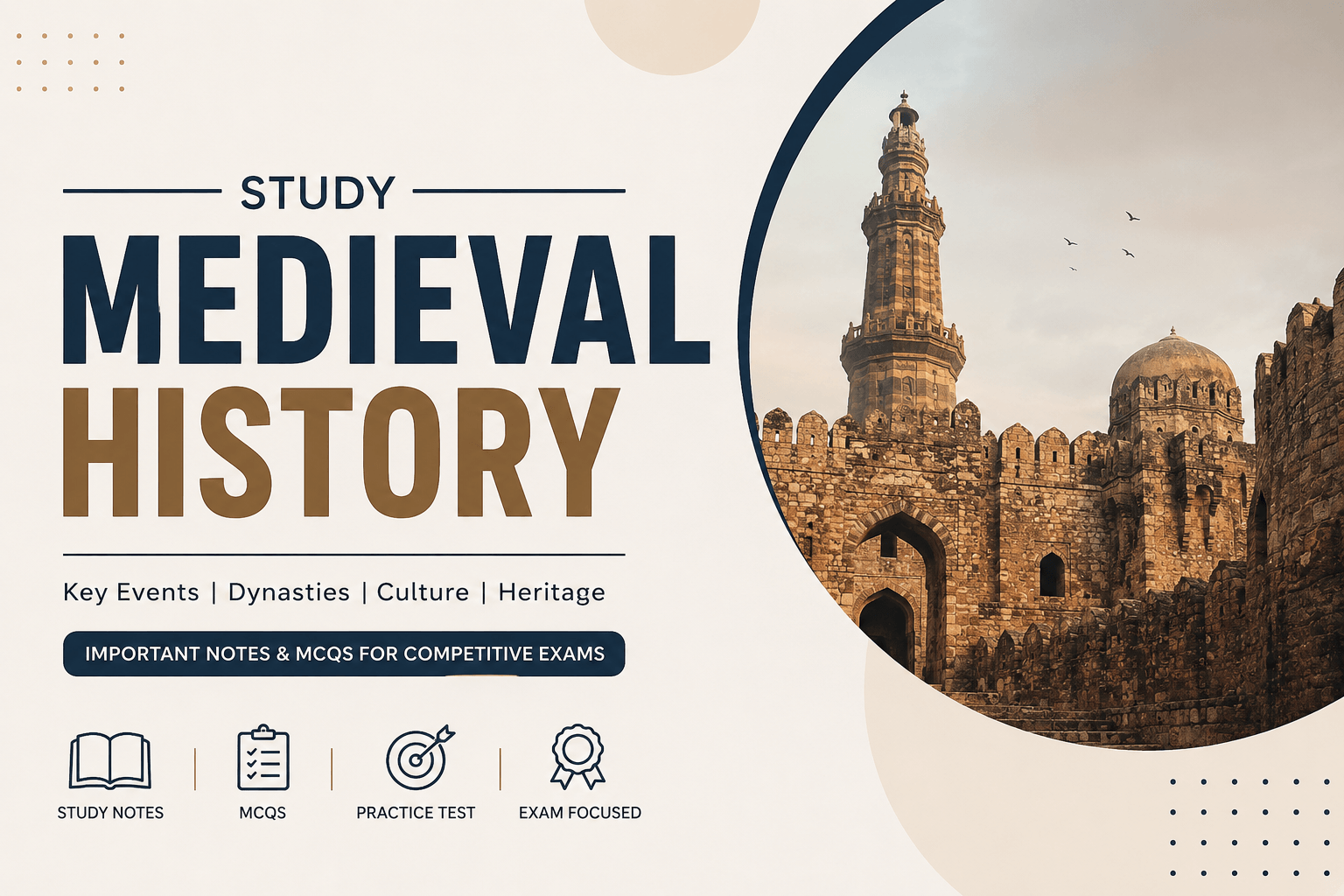
Medieval Indian History Notes for SSC, Railway & Competitive Exams
Medieval Indian History is an important section of General Awareness for SSC, Railway, Banking, Defence and other competitive examinations. These notes explain the Delhi Sultanate, Vijayanagara Empire, Mughal Empire, Bhakti Movement, Sufi Movement and other important topics in simple English for quick learning and revision.
Introduction
The Medieval Period of Indian History extends roughly from the 8th century CE to the 18th century CE. This period witnessed the rise of powerful kingdoms, the establishment of the Delhi Sultanate, the growth of regional empires, the emergence of the Mughal Empire, and important religious movements such as the Bhakti and Sufi movements.
Questions from Medieval History are regularly asked in SSC, Railway, Banking, Police and State Government examinations. Most questions are based on rulers, dynasties, monuments, administrative systems, literature and religious reformers.
- Delhi Sultanate
- Slave Dynasty
- Khilji Dynasty
- Tughlaq Dynasty
- Lodhi Dynasty
- Vijayanagara Empire
- Mughal Empire
- Bhakti & Sufi Movements
Timeline of Medieval India
Rajput Kingdoms
8th–12th CenturyDelhi Sultanate
1206–1526Vijayanagara Empire
1336–1646Mughal Empire
1526–1857Early Medieval India
The Early Medieval Period began after the decline of the Gupta Empire. During this period, many regional kingdoms emerged across India. These kingdoms played an important role in the development of Indian culture, architecture, literature and trade.
Major Regional Kingdoms
| Kingdom | Region |
|---|---|
| Gurjara-Pratiharas | North India |
| Palas | Bengal & Bihar |
| Rashtrakutas | Deccan Region |
| Cholas | South India |
- The Gurjara-Pratiharas protected north-western India from foreign invasions.
- The Palas were great patrons of Buddhism.
- The Rashtrakutas built the famous Kailasa Temple at Ellora.
- The Cholas developed a powerful navy and promoted overseas trade.
- G → Gurjara-Pratihara
- P → Pala
- R → Rashtrakuta
- C → Chola
Quick Revision
- Important kingdoms after the Gupta Empire.
- Palas promoted Buddhism.
- Rashtrakutas built the Kailasa Temple.
- Cholas were famous for naval power.
Delhi Sultanate (1206–1526)
The Delhi Sultanate was established in 1206 CE after the death of Muhammad Ghori. It ruled large parts of northern India for more than three centuries. The Sultanate consisted of five major dynasties that strengthened administration, trade and architecture.
Five Dynasties of the Delhi Sultanate
| Dynasty | Founder |
|---|---|
| Slave Dynasty | Qutb-ud-din Aibak |
| Khilji Dynasty | Jalal-ud-din Khilji |
| Tughlaq Dynasty | Ghiyas-ud-din Tughlaq |
| Sayyid Dynasty | Khizr Khan |
| Lodhi Dynasty | Bahlul Lodhi |
Important Rulers
| Ruler | Contribution |
|---|---|
| Qutb-ud-din Aibak | Founder of the Slave Dynasty; started the construction of Qutub Minar. |
| Iltutmish | Strengthened the Delhi Sultanate and introduced the Iqta system. |
| Razia Sultan | First and only woman ruler of the Delhi Sultanate. |
| Alauddin Khilji | Introduced market control and price regulations. |
| Muhammad bin Tughlaq | Introduced token currency and shifted the capital to Daulatabad. |
| Firoz Shah Tughlaq | Built canals, gardens and public welfare works. |
- Qutb-ud-din Aibak founded the Delhi Sultanate in 1206.
- Iltutmish completed the construction of the Qutub Minar.
- Razia Sultan was the first woman Sultan of Delhi.
- Alauddin Khilji is famous for his market reforms.
- Muhammad bin Tughlaq introduced token currency.
- The Lodhi Dynasty was the last ruling dynasty of the Delhi Sultanate.
Quick Revision
- Delhi Sultanate → 1206–1526
- Founder → Qutb-ud-din Aibak
- First Woman Ruler → Razia Sultan
- Market Reforms → Alauddin Khilji
- Token Currency → Muhammad bin Tughlaq
- Last Dynasty → Lodhi Dynasty
Vijayanagara Empire (1336–1646 CE)
The Vijayanagara Empire was one of the greatest Hindu kingdoms in South India. It was founded in 1336 CE by Harihara I and Bukka Raya I with the guidance of the saint Vidyaranya. The capital of the empire was Hampi, which is now a UNESCO World Heritage Site.
The empire became famous for its efficient administration, flourishing trade, magnificent temples, literature and strong military. It reached its greatest glory under the rule of Krishnadevaraya.
- Founder of the Vijayanagara Empire
- Capital – Hampi
- Krishnadevaraya
- Talikota Battle (1565)
Important Rulers
| Ruler | Contribution |
|---|---|
| Harihara I | Co-founder of the empire. |
| Bukka Raya I | Expanded the kingdom. |
| Krishnadevaraya | Greatest ruler; promoted literature, art and trade. |
- Capital → Hampi
- Greatest ruler → Krishnadevaraya
- Foreign traveller Domingo Paes visited during Krishnadevaraya’s reign.
- The empire declined after the Battle of Talikota (1565).
- H → Harihara
- H → Hampi
- K → Krishnadevaraya
- T → Talikota
Quick Revision
- Founded → 1336 CE
- Capital → Hampi
- Greatest ruler → Krishnadevaraya
- Battle of Talikota → 1565
Bahmani Kingdom
The Bahmani Kingdom was the first independent Muslim kingdom in the Deccan region. It was founded by Ala-ud-Din Bahman Shah in 1347 CE. Initially, its capital was Gulbarga, which was later shifted to Bidar.
The Bahmani rulers frequently fought with the Vijayanagara Empire for control over the fertile Raichur Doab region.
- Founded in 1347 CE.
- Founder → Ala-ud-Din Bahman Shah.
- First Capital → Gulbarga.
- Later Capital → Bidar.
- Main rival → Vijayanagara Empire.
Quick Revision
- Founder → Bahman Shah
- Capital → Gulbarga → Bidar
- Main rival → Vijayanagara Empire
Mughal Empire (1526–1857 CE)
The Mughal Empire was founded by Babur after defeating Ibrahim Lodhi in the First Battle of Panipat (1526). The Mughal period is known for its strong administration, magnificent architecture, cultural development and expansion of trade.
Among all Mughal rulers, Akbar is regarded as the greatest because of his administrative reforms, religious tolerance and territorial expansion.
- Battle of Panipat
- Akbar’s administration
- Din-i-Ilahi
- Taj Mahal
- Aurangzeb
Important Mughal Rulers
| Ruler | Contribution |
|---|---|
| Babur | Founded the Mughal Empire after the First Battle of Panipat (1526). |
| Humayun | Lost the empire to Sher Shah Suri but later regained it. |
| Akbar | Expanded the empire and introduced religious tolerance. |
| Jahangir | Known for the Chain of Justice. |
| Shah Jahan | Built the Taj Mahal. |
| Aurangzeb | Last powerful Mughal ruler. |
Akbar (1556–1605)
Akbar is considered the greatest Mughal emperor. He strengthened the Mughal administration, expanded the empire and followed a policy of religious tolerance. He abolished the Jizya tax for some time and introduced the policy of Sulh-i-Kul (Universal Peace).
Important Contributions
- Introduced the Mansabdari System.
- Started Din-i-Ilahi in 1582.
- Built Fatehpur Sikri.
- Encouraged art, literature and music.
- Navratnas (Nine Gems) adorned his court.
- Abul Fazl
- Faizi
- Birbal
- Tansen
- Raja Todar Mal
- Raja Man Singh
- Abdul Rahim Khan-i-Khana
- Fakir Aziao-Din
- Mulla Do Piaza (traditional account)
Quick Revision
- Greatest Mughal ruler → Akbar
- Din-i-Ilahi → 1582
- Mansabdari System
- Capital → Fatehpur Sikri (for a period)
Shah Jahan and Aurangzeb
Shah Jahan is remembered for his magnificent architectural works, while Aurangzeb was the last powerful Mughal ruler. During Aurangzeb’s reign, the Mughal Empire reached its maximum territorial extent, but continuous wars weakened the empire.
| Ruler | Important Fact |
|---|---|
| Shah Jahan | Built the Taj Mahal, Red Fort and Jama Masjid. |
| Aurangzeb | Expanded the empire to its greatest size but faced many revolts. |
- Taj Mahal is located in Agra.
- The Taj Mahal was built in memory of Mumtaz Mahal.
- Red Fort is located in Delhi.
- Aurangzeb was the last major Mughal emperor.
Quick Revision
- Founder → Babur
- Greatest ruler → Akbar
- Taj Mahal → Shah Jahan
- Last powerful ruler → Aurangzeb
Bhakti Movement
The Bhakti Movement was a religious reform movement that began in South India around the 7th century CE and later spread to different parts of India. The movement emphasized devotion (Bhakti) to God rather than elaborate rituals. It also promoted equality, love, social harmony and religious tolerance.
Bhakti saints composed devotional songs in regional languages, making religious teachings easy for ordinary people to understand. The movement played an important role in reducing social discrimination and encouraging unity.
- Important Bhakti Saints
- Teachings of Kabir and Guru Nanak
- Founder of Sikhism
- Regional Bhakti Saints
Important Bhakti Saints
| Saint | Main Teaching |
|---|---|
| Ramanuja | Devotion to Lord Vishnu. |
| Ramananda | Spread Bhakti in North India. |
| Kabir | Believed in one God and opposed religious discrimination. |
| Guru Nanak | Founder of Sikhism; preached equality and devotion. |
| Chaitanya Mahaprabhu | Promoted devotion to Lord Krishna. |
| Mirabai | Famous devotee of Lord Krishna. |
| Tulsidas | Author of Ramcharitmanas. |
- Guru Nanak founded Sikhism.
- Kabir opposed caste discrimination and religious divisions.
- Tulsidas wrote Ramcharitmanas in Awadhi.
- Mirabai was devoted to Lord Krishna.
Quick Revision
- Founder of Sikhism → Guru Nanak
- Ramcharitmanas → Tulsidas
- One God → Kabir
- Krishna devotee → Mirabai
Sufi Movement
The Sufi Movement emphasized love, peace, humanity and devotion to God. Sufi saints believed that God could be reached through love, service and spiritual discipline rather than external rituals. Their teachings encouraged communal harmony and influenced Indian culture.
Important Sufi Saints
| Saint | Important Information |
|---|---|
| Khwaja Moinuddin Chishti | Founded the Chishti Order in India; shrine at Ajmer. |
| Nizamuddin Auliya | Famous Chishti saint of Delhi. |
| Baba Farid | Important Punjabi Sufi saint. |
| Sheikh Salim Chishti | Lived at Fatehpur Sikri during Akbar’s reign. |
- Ajmer Sharif is the shrine of Khwaja Moinuddin Chishti.
- Nizamuddin Auliya was one of the most respected Sufi saints.
- Sufi saints emphasized peace, love and equality.
Quick Revision
- Ajmer → Khwaja Moinuddin Chishti
- Delhi → Nizamuddin Auliya
- Main teaching → Love and humanity
Architecture During the Medieval Period
The Medieval Period witnessed remarkable developments in architecture. Hindu, Islamic and Mughal styles blended to create unique monuments that are still admired today.
| Monument | Built By |
|---|---|
| Qutub Minar | Started by Qutb-ud-din Aibak and completed by Iltutmish. |
| Alai Darwaza | Alauddin Khilji. |
| Humayun’s Tomb | Built during Akbar’s reign by Haji Begum. |
| Fatehpur Sikri | Akbar. |
| Taj Mahal | Shah Jahan. |
| Red Fort | Shah Jahan. |
| Jama Masjid | Shah Jahan. |
Literature During the Medieval Period
| Author | Famous Work |
|---|---|
| Amir Khusrau | Persian poetry and music. |
| Tulsidas | Ramcharitmanas. |
| Abul Fazl | Akbarnama and Ain-i-Akbari. |
| Kalhana | Rajatarangini. |
- Abul Fazl was one of Akbar’s Navratnas.
- Akbarnama describes Akbar’s reign.
- Ain-i-Akbari gives details of Akbar’s administration.
- Rajatarangini is an important historical work on Kashmir.
Important Terms for Competitive Exams
📌 One-Minute Revision
- ✔ Delhi Sultanate ruled from 1206 to 1526 CE.
- ✔ Qutb-ud-din Aibak founded the Slave Dynasty.
- ✔ Razia Sultan was the first and only woman ruler of the Delhi Sultanate.
- ✔ Alauddin Khilji introduced market reforms.
- ✔ Muhammad bin Tughlaq introduced token currency.
- ✔ Vijayanagara Empire was founded by Harihara I and Bukka Raya I.
- ✔ Hampi was the capital of the Vijayanagara Empire.
- ✔ Babur founded the Mughal Empire after the First Battle of Panipat (1526).
- ✔ Akbar introduced the Mansabdari System and Din-i-Ilahi.
- ✔ Shah Jahan built the Taj Mahal.
- ✔ Guru Nanak founded Sikhism.
- ✔ Khwaja Moinuddin Chishti’s shrine is located at Ajmer.
Conclusion
Medieval Indian History is an important part of the General Awareness syllabus for SSC, Railway, Banking, Defence, Police and other competitive examinations. A clear understanding of the Delhi Sultanate, Vijayanagara Empire, Mughal Empire, Bhakti Movement and Sufi Movement helps candidates answer many objective questions with confidence.
Regular revision of important rulers, battles, monuments, literary works and administrative reforms is essential for scoring well. Practice topic-wise MCQs after completing these notes to strengthen your preparation and improve your accuracy in the examination.