
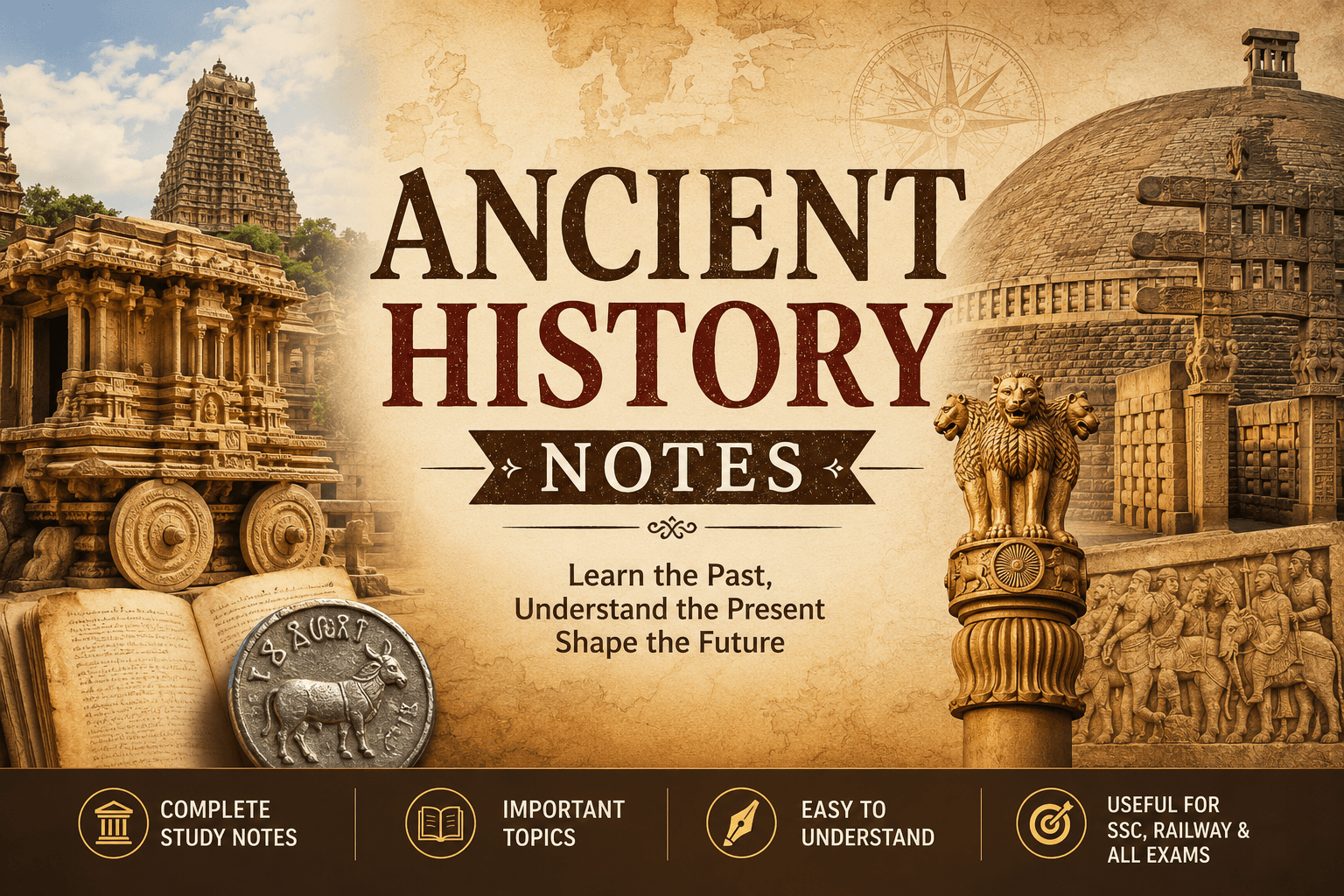
Ancient Indian History Notes for SSC, Railway & Competitive Exams
Ancient Indian History is one of the most important topics in the General Awareness section of competitive exams. These notes explain important civilizations, kingdoms, religions and historical developments in simple English with exam-oriented facts for quick revision.
Introduction
Ancient Indian History covers the period from the earliest human settlements to the end of the Gupta Empire. It explains how early humans lived, how the first civilizations developed, how kingdoms were formed and how religions such as Buddhism and Jainism spread across India.
Questions from Ancient History are regularly asked in SSC, Railway, Banking, Defence and State Government examinations. Most questions are factual and require knowledge of important rulers, archaeological sites, religious founders, capitals and historical events.
- Stone Age
- Indus Valley Civilization
- Vedic Age
- Jainism
- Buddhism
- Mahajanapadas
- Mauryan Empire
- Gupta Empire
Timeline of Ancient India
Stone Age
2.5 Million BCEIndus Valley
2500–1750 BCEVedic Age
1500–600 BCEMahajanapadas
600 BCEMauryan Empire
322 BCEGupta Empire
320 CEStone Age
The Stone Age is the earliest period of human history. During this period, humans used tools made mainly from stone. People survived by hunting animals, gathering fruits and fishing. Gradually, they learned farming and began living in permanent settlements.
Types of Stone Age
| Period | Main Feature |
|---|---|
| Palaeolithic Age | Humans lived as hunters and food gatherers. |
| Mesolithic Age | Use of small stone tools (Microliths) and domestication of animals. |
| Neolithic Age | Agriculture, pottery and permanent settlements developed. |
- The earliest stone tools were made during the Palaeolithic Age.
- Bhimbetka Rock Shelters in Madhya Pradesh are famous for prehistoric cave paintings.
- The Neolithic Age is known as the beginning of farming in India.
- People started making polished stone tools during the Neolithic period.
- P = Palaeolithic (Old Stone Age)
- M = Mesolithic (Middle Stone Age)
- N = Neolithic (New Stone Age)
Quick Revision
- Oldest period of human history.
- Main tools were made of stone.
- Agriculture began during the Neolithic Age.
- Bhimbetka is famous for prehistoric rock paintings.
Indus Valley Civilization (Harappan Civilization)
The Indus Valley Civilization was one of the world’s earliest urban civilizations. It flourished mainly in present-day Pakistan and north-western India. The civilization is famous for its well-planned cities, advanced drainage system, trade, craftsmanship and standardized weights and measures.
It is also known as the Harappan Civilization because Harappa was the first site discovered by archaeologists.
Main Features
- Well-planned cities with grid pattern.
- Advanced underground drainage system.
- Houses made of baked bricks.
- Trade with Mesopotamia.
- Standardized weights and measures.
- No clear evidence of large temples.
Important Sites
| Site | Importance |
|---|---|
| Harappa | First discovered site |
| Mohenjo-daro | Great Bath |
| Lothal | Dockyard |
| Dholavira | Excellent water management system |
| Kalibangan | Evidence of ploughed field |
- Harappa was discovered by Dayaram Sahni in 1921.
- Mohenjo-daro was excavated by Rakhaldas Banerji in 1922.
- The Great Bath is located at Mohenjo-daro.
- Lothal is famous for its dockyard.
- Dholavira is known for advanced water conservation.
- The civilization had no deciphered script.
- H → Harappa → First discovered site
- G → Great Bath → Mohenjo-daro
- D → Dockyard → Lothal
- L → Largest planned cities
- K → Kalibangan → Ploughed field
Quick Revision
- First urban civilization of India.
- Known for planned cities and drainage.
- Great Bath → Mohenjo-daro.
- Dockyard → Lothal.
- First discovered site → Harappa.
- Questions from this topic are very common in SSC & Railway exams.
Vedic Age
The Vedic Age marks the period when the Indo-Aryans settled in northern India and composed the Vedas, the oldest sacred texts of Hinduism. It followed the decline of the Indus Valley Civilization and is generally divided into the Early Vedic Period (1500–1000 BCE) and the Later Vedic Period (1000–600 BCE).
Society, religion, agriculture, political organization and trade developed significantly during this period. Many important concepts of Indian civilization have their roots in the Vedic Age.
The Four Vedas
| Veda | Main Subject |
|---|---|
| Rigveda | Oldest Veda containing hymns dedicated to various gods. |
| Samaveda | Collection of hymns mainly used for singing. |
| Yajurveda | Rituals and sacrificial ceremonies. |
| Atharvaveda | Magic, medicine, prayers and daily life. |
Important Features
- Rigveda is the oldest Veda.
- The Sapta Sindhu (Land of Seven Rivers) was the main region of the Early Vedic people.
- The king was called Rajan.
- Popular assemblies included Sabha and Samiti.
- Cattle were considered the main measure of wealth.
- Agriculture became more important during the Later Vedic Period.
- The Varna system became more organized during the Later Vedic Age.
- Rigveda is the oldest literary source of Ancient India.
- The river Saraswati is mentioned frequently in the Rigveda.
- Iron became common during the Later Vedic Period.
- Permanent settlements increased after agriculture expanded.
- R → Rigveda
- S → Samaveda
- Y → Yajurveda
- A → Atharvaveda
Quick Revision
- Oldest Veda → Rigveda
- King → Rajan
- Assemblies → Sabha & Samiti
- Main wealth → Cattle
- Iron became common in the Later Vedic Period.
Mahajanapadas
By the 6th century BCE, several powerful kingdoms had emerged in northern India. These kingdoms were called the Mahajanapadas. There were sixteen major Mahajanapadas, which competed for political power and controlled trade routes and fertile lands.
Important Mahajanapadas
| Mahajanapada | Capital |
|---|---|
| Magadha | Rajagriha (later Pataliputra) |
| Kosala | Sravasti |
| Vatsa | Kaushambi |
| Avanti | Ujjain |
- There were 16 Mahajanapadas.
- Magadha became the most powerful kingdom.
- Bimbisara and Ajatashatru were important rulers of Magadha.
- Pataliputra later became an important political centre.
Quick Revision
- Total Mahajanapadas → 16
- Most Powerful → Magadha
- Capital of Magadha → Rajagriha (later Pataliputra)
Jainism
Jainism is one of the oldest religions of India. It teaches non-violence, truth, self-discipline and spiritual purification. According to Jain tradition, there were 24 Tirthankaras, of whom Mahavira was the last and most important.
Mahavira
- 24th Tirthankara.
- Born at Kundagrama in present-day Bihar.
- Father – Siddhartha.
- Mother – Trishala.
- Attained Kevala Jnana (Supreme Knowledge).
- Attained Nirvana at Pavapuri.
- Ahimsa (Non-violence)
- Satya (Truth)
- Asteya (Non-stealing)
- Aparigraha (Non-possession)
- Brahmacharya (Celibacy)
Quick Revision
- Founder (historically associated) → Mahavira
- 24 Tirthankaras
- Nirvana → Pavapuri
- Main teaching → Ahimsa
Buddhism
Buddhism was founded by Gautama Buddha during the 6th century BCE. It emphasizes the Middle Path, compassion, wisdom and freedom from suffering. The religion spread rapidly across India and later to many parts of Asia.
Life of Gautama Buddha
| Event | Place |
|---|---|
| Birth | Lumbini |
| Enlightenment | Bodh Gaya |
| First Sermon | Sarnath |
| Mahaparinirvana | Kushinagar |
Four Noble Truths
- Life is full of suffering.
- Suffering has a cause.
- Suffering can end.
- The Eightfold Path leads to the end of suffering.
- Buddha belonged to the Shakya clan.
- His childhood name was Siddhartha.
- He attained enlightenment under the Bodhi Tree at Bodh Gaya.
- The first sermon is known as the “Dharmachakra Pravartana”.
- Buddhist councils helped preserve Buddha’s teachings.
- L → Lumbini (Birth)
- B → Bodh Gaya (Enlightenment)
- S → Sarnath (First Sermon)
- K → Kushinagar (Mahaparinirvana)
Quick Revision
- Birth → Lumbini
- Enlightenment → Bodh Gaya
- First Sermon → Sarnath
- Mahaparinirvana → Kushinagar
- Main teachings → Four Noble Truths & Eightfold Path
Mauryan Empire (322 BCE – 185 BCE)
The Mauryan Empire was the first large empire to unite most parts of the Indian subcontinent under one administration. It was founded by Chandragupta Maurya in 322 BCE after defeating the Nanda dynasty with the guidance of his teacher Chanakya (Kautilya). The empire reached its greatest extent during the reign of Emperor Ashoka.
The Mauryan period is considered a golden phase of political organization because it introduced a strong central administration, efficient taxation system, organized army and improved trade. Questions from this topic are frequently asked in SSC, Railway and Banking examinations.
- Founder of the Mauryan Empire
- Chanakya and Arthashastra
- Megasthenes
- Ashoka’s Dhamma
- Kalinga War
- Ashokan Inscriptions
Important Mauryan Rulers
| Ruler | Important Contribution |
|---|---|
| Chandragupta Maurya | Founded the Mauryan Empire and defeated the Nanda dynasty. |
| Bindusara | Expanded the empire towards southern India. |
| Ashoka | Adopted Buddhism after the Kalinga War and promoted Dhamma. |
Quick Revision
- Founder → Chandragupta Maurya
- Second ruler → Bindusara
- Greatest ruler → Ashoka
Chandragupta Maurya
Chandragupta Maurya founded the Mauryan Empire in 322 BCE. He overthrew the Nanda dynasty and established a powerful centralized kingdom. His mentor, Chanakya (Kautilya), played an important role in planning the empire and wrote the famous book Arthashastra, which explains administration, economy, taxation and diplomacy.
The Greek ambassador Megasthenes visited Chandragupta’s court and wrote the book Indica, which provides valuable information about ancient India.
- Founder of the Mauryan Empire.
- Advisor – Chanakya (Kautilya).
- Book written by Chanakya – Arthashastra.
- Greek ambassador – Megasthenes.
- Book written by Megasthenes – Indica.
- C → Chandragupta
- A → Arthashastra
- M → Megasthenes
- I → Indica
Emperor Ashoka
Ashoka was the greatest ruler of the Mauryan Empire. At the beginning of his reign, he followed a policy of military expansion. However, after the bloody Kalinga War (261 BCE), he was deeply moved by the suffering caused by war and accepted Buddhism.
Ashoka promoted peace, religious tolerance and moral values through his policy of Dhamma. He issued his messages through inscriptions carved on rocks and pillars across the empire.
Ashoka’s Contributions
- Spread Buddhism inside and outside India.
- Sent missionaries to Sri Lanka and other countries.
- Built stupas, monasteries and pillars.
- Promoted non-violence and religious harmony.
- Issued Rock Edicts and Pillar Edicts.
- Kalinga War took place around 261 BCE.
- The Lion Capital of Sarnath was built during Ashoka’s reign.
- The Lion Capital is the National Emblem of India.
- The Ashoka Chakra appears on the National Flag of India.
- Most Ashokan inscriptions were written in the Brahmi script.
Quick Revision
- Greatest Mauryan ruler → Ashoka
- Kalinga War → 261 BCE
- National Emblem → Lion Capital of Sarnath
- National Flag → Ashoka Chakra
- Policy → Dhamma
Post-Mauryan Kingdoms
After the fall of the Mauryan Empire in 185 BCE, several regional kingdoms emerged in different parts of India. These kingdoms contributed to trade, art, culture and the spread of Buddhism.
| Kingdom | Important Contribution |
|---|---|
| Shunga Dynasty | Founded by Pushyamitra Shunga. |
| Satavahana Dynasty | Promoted trade and ruled the Deccan region. |
| Indo-Greeks | Introduced Greek influence in north-western India. |
| Kushana Empire | Ruled by Kanishka, promoted Buddhism. |
- Pushyamitra Shunga founded the Shunga Dynasty.
- Kanishka was the greatest Kushana ruler.
- The Fourth Buddhist Council was held during Kanishka’s reign.
- Satavahanas were important rulers of the Deccan.
Quick Revision
- Shunga → Pushyamitra
- Kushana → Kanishka
- Satavahana → Deccan
- Fourth Buddhist Council → Kanishka
Gupta Empire (320 CE – 550 CE)
The Gupta Empire is known as the “Golden Age of Ancient India” because of remarkable progress in literature, science, mathematics, astronomy, art and architecture. The empire was founded by Chandragupta I around 320 CE and reached its peak under Samudragupta and Chandragupta II (Vikramaditya).
The Gupta rulers encouraged education, trade and cultural development. Many famous scholars, poets and scientists flourished during this period, making it one of the most glorious phases of Indian history.
- Founder of the Gupta Empire
- Golden Age of India
- Samudragupta
- Chandragupta II (Vikramaditya)
- Aryabhata
- Kalidasa
- Nalanda University
Important Gupta Rulers
| Ruler | Contribution |
|---|---|
| Chandragupta I | Founder of the Gupta Empire. |
| Samudragupta | Expanded the empire through successful military campaigns. |
| Chandragupta II (Vikramaditya) | Patron of art, literature and trade. |
- Samudragupta is known as the “Napoleon of India”.
- The Allahabad Pillar Inscription describes his achievements.
- Chandragupta II defeated the Shakas.
- Chinese traveller Fa-Hien visited India during Chandragupta II’s reign.
Quick Revision
- Founder → Chandragupta I
- Great conqueror → Samudragupta
- Fa-Hien visited during → Chandragupta II
- Golden Age → Gupta Period
Science, Literature and Education
The Gupta Age witnessed extraordinary achievements in science, mathematics and literature. Scholars made important discoveries that influenced the development of knowledge in India and abroad.
| Scholar | Contribution |
|---|---|
| Aryabhata | Great mathematician and astronomer; wrote Aryabhatiya. |
| Kalidasa | Famous Sanskrit poet and dramatist. |
| Varahamihira | Important astronomer and scientist. |
| Amarasimha | Compiled the Sanskrit dictionary Amarakosha. |
- Nalanda became an important centre of learning.
- Aryabhata explained the rotation of the Earth.
- Kalidasa wrote famous works like Abhijnanasakuntalam.
- The decimal system and mathematical developments flourished during this period.
Sangam Age
The Sangam Age refers to the early historic period of South India, mainly in present-day Tamil Nadu. It is famous for Tamil literature, flourishing trade, agriculture and maritime activities. Sangam literature provides valuable information about the political, social and cultural life of the people.
Three Important Tamil Kingdoms
| Kingdom | Capital |
|---|---|
| Chera | Vanji |
| Chola | Uraiyur |
| Pandya | Madurai |
- Sangam literature was written in Tamil.
- Madurai was an important cultural centre.
- Roman trade flourished during this period.
- Pearls, spices and textiles were major export items.
Quick Revision
- Language → Tamil
- Cultural Centre → Madurai
- Three Kingdoms → Chera, Chola, Pandya
Important Terms for Competitive Exams
📌 One-Minute Revision
- ✔ Stone Age → Palaeolithic, Mesolithic and Neolithic.
- ✔ Indus Valley Civilization → Great Bath (Mohenjo-daro), Dockyard (Lothal).
- ✔ Oldest Veda → Rigveda.
- ✔ Total Mahajanapadas → 16.
- ✔ 24th Tirthankara → Mahavira.
- ✔ Gautama Buddha attained enlightenment at Bodh Gaya.
- ✔ Founder of the Mauryan Empire → Chandragupta Maurya.
- ✔ Chanakya wrote Arthashastra.
- ✔ Ashoka adopted Buddhism after the Kalinga War.
- ✔ Lion Capital of Sarnath is India’s National Emblem.
- ✔ Gupta Period is known as the Golden Age of Ancient India.
- ✔ Aryabhata was a great mathematician and astronomer.
- ✔ Sangam literature was written in Tamil.
Chapter Summary
Ancient Indian History covers the journey of human civilization from the Stone Age to the Gupta Empire. It includes the rise of the Indus Valley Civilization, the Vedic Age, the emergence of Mahajanapadas, the teachings of Jainism and Buddhism, the establishment of the Mauryan Empire and the cultural achievements of the Gupta Empire. Understanding these topics helps students answer many factual questions asked in SSC, Railway, Banking and other competitive examinations.
📌 Final Revision Checklist
- ✔ Stone Age consists of Palaeolithic, Mesolithic and Neolithic periods.
- ✔ Harappa was the first discovered site of the Indus Valley Civilization.
- ✔ Mohenjo-daro is famous for the Great Bath.
- ✔ Lothal is famous for its Dockyard.
- ✔ Rigveda is the oldest Veda.
- ✔ There were 16 Mahajanapadas.
- ✔ Mahavira was the 24th Tirthankara of Jainism.
- ✔ Gautama Buddha attained enlightenment at Bodh Gaya.
- ✔ Chandragupta Maurya founded the Mauryan Empire.
- ✔ Chanakya wrote the Arthashastra.
- ✔ Ashoka embraced Buddhism after the Kalinga War.
- ✔ The Gupta Period is known as the Golden Age of Ancient India.
Conclusion
Ancient Indian History is one of the most important and scoring subjects for SSC, Railway, Banking, Defence, Police and other competitive examinations. Questions are frequently asked about the Stone Age, Indus Valley Civilization, Vedic Age, Jainism, Buddhism, Mauryan Empire and Gupta Empire.
To score well in the examination, revise important rulers, archaeological sites, religious teachings, capitals and timelines regularly. Consistent revision along with topic-wise MCQ practice will help you improve both speed and accuracy.
These Ancient Indian History Notes are designed to provide complete yet easy-to-understand study material for competitive exam aspirants. Save this page for quick revision and strengthen your preparation with regular practice.