
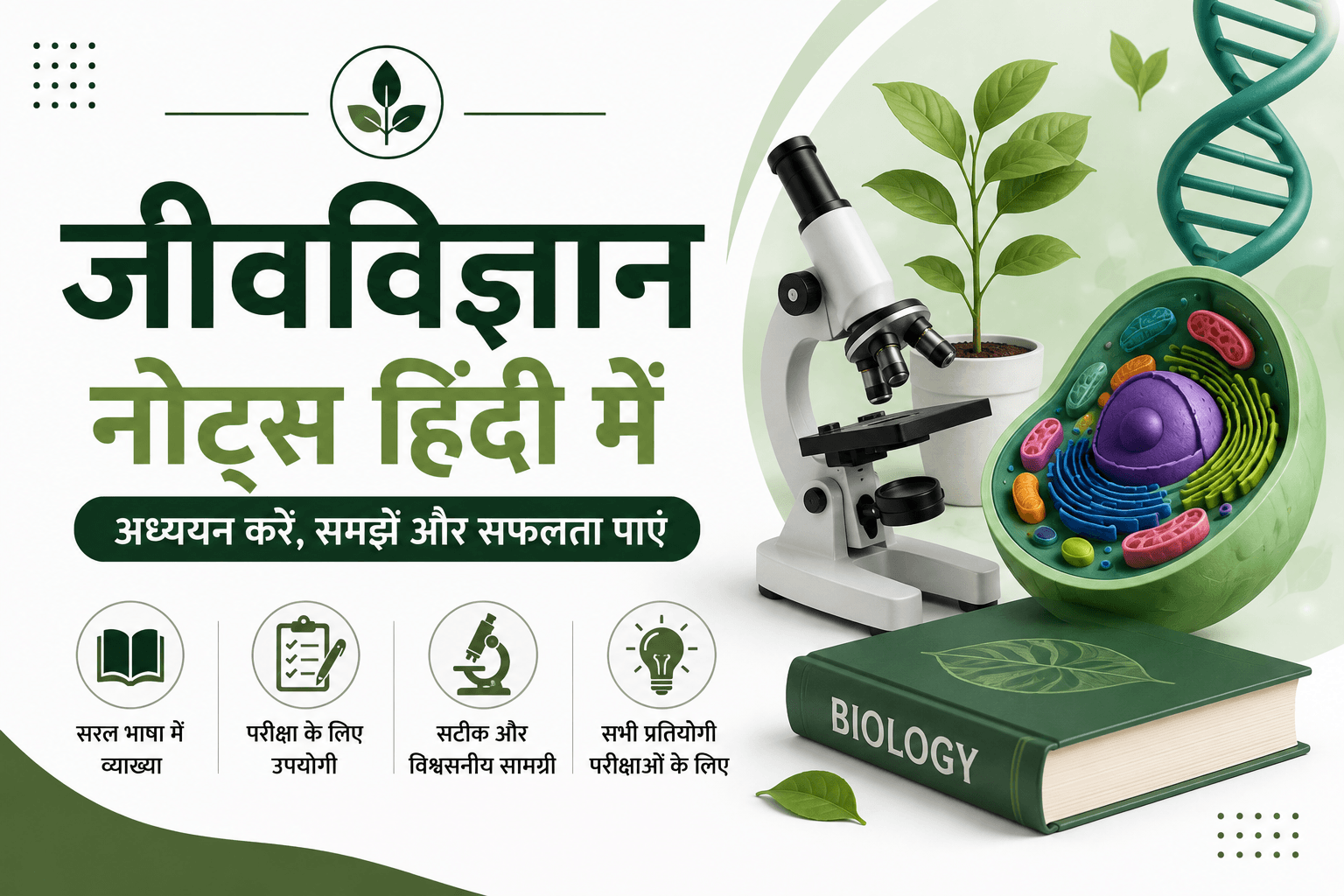
जीव विज्ञान क्या है? – Biology in Hindi
जीव विज्ञान (Biology) विज्ञान की वह शाखा है जिसमें जीवित प्राणियों, उनकी संरचना, कार्य, वृद्धि, विकास, प्रजनन तथा पर्यावरण के साथ उनके संबंधों का अध्ययन किया जाता है।
प्रतियोगी परीक्षाओं में Biology से कोशिका, ऊतक, मानव शरीर, पाचन, रक्त परिसंचरण, श्वसन, रोग, पोषण, पादप विज्ञान, आनुवंशिकी और पारिस्थितिकी जैसे विषयों से प्रश्न पूछे जाते हैं।
SSC, Railway और अन्य प्रतियोगी परीक्षाओं के लिए Biology पढ़ते समय Human Body, Diseases, Vitamins, Cell Biology, Genetics और Plant Biology पर विशेष ध्यान दें।
जीव विज्ञान की प्रमुख शाखाएँ
| शाखा | अध्ययन |
|---|---|
| Botany | पौधों का अध्ययन |
| Zoology | जंतुओं का अध्ययन |
| Microbiology | सूक्ष्मजीवों का अध्ययन |
| Cytology | कोशिकाओं का अध्ययन |
| Histology | ऊतकों का अध्ययन |
| Genetics | आनुवंशिकता और विविधता का अध्ययन |
| Ecology | जीवों और पर्यावरण के पारस्परिक संबंधों का अध्ययन |
| Anatomy | शरीर की संरचना का अध्ययन |
| Physiology | जीवों और उनके अंगों के कार्यों का अध्ययन |
जीव विज्ञान के जनक – Father of Biology
प्राचीन यूनानी दार्शनिक एवं वैज्ञानिक अरस्तू (Aristotle) को सामान्यतः जीव विज्ञान का जनक कहा जाता है।
Father of Biology → Aristotle
Father of Zoology → Aristotle
Father of Botany → Theophrastus
Father of Genetics → Gregor Mendel
जीवों की प्रमुख विशेषताएँ
जीवित प्राणियों में कई सामान्य biological characteristics पाई जाती हैं। इनमें प्रमुख हैं:
- पोषण – Nutrition
- श्वसन – Respiration
- वृद्धि – Growth
- उत्सर्जन – Excretion
- प्रजनन – Reproduction
- उत्तेजना के प्रति प्रतिक्रिया – Response to Stimuli
- उपापचय – Metabolism
संगठन के जैविक स्तर – Levels of Organization
बहुकोशिकीय जीवों में शरीर का संगठन सामान्यतः छोटे स्तर से बड़े स्तर की ओर इस प्रकार समझा जा सकता है:
Cell → Tissue → Organ → Organ System → Organism
कोशिका (Cell) जीवों की संरचनात्मक और क्रियात्मक मूल इकाई मानी जाती है।
एककोशिकीय और बहुकोशिकीय जीव
एककोशिकीय जीव – Unicellular Organisms
ऐसे जीव जिनका शरीर मुख्यतः एक कोशिका से बना होता है, एककोशिकीय जीव कहलाते हैं।
उदाहरण: Amoeba, Paramecium और कई bacteria।
बहुकोशिकीय जीव – Multicellular Organisms
ऐसे जीव जिनका शरीर अनेक कोशिकाओं से मिलकर बना होता है, बहुकोशिकीय जीव कहलाते हैं।
उदाहरण: मनुष्य, अधिकांश पशु और अधिकांश पौधे।
स्वपोषी और परपोषी पोषण
स्वपोषी – Autotrophic
ऐसे जीव जो आवश्यक कच्चे पदार्थों से अपना भोजन स्वयं बनाते हैं, autotrophs कहलाते हैं। हरे पौधे प्रकाश संश्लेषण द्वारा अपना भोजन बनाते हैं।
परपोषी – Heterotrophic
ऐसे जीव जो भोजन के लिए प्रत्यक्ष या अप्रत्यक्ष रूप से अन्य जीवों पर निर्भर होते हैं, heterotrophs कहलाते हैं।
मनुष्य और अन्य animals इसके प्रमुख उदाहरण हैं।
वैज्ञानिक नामकरण – Binomial Nomenclature
जीवों के वैज्ञानिक नामकरण की widely used प्रणाली Binomial Nomenclature कहलाती है। इसमें प्रत्येक species का वैज्ञानिक नाम सामान्यतः दो भागों में लिखा जाता है: Genus और specific epithet।
इस प्रणाली को व्यवस्थित रूप से लोकप्रिय बनाने का श्रेय Carolus Linnaeus को दिया जाता है।
मनुष्य का वैज्ञानिक नाम → Homo sapiens
वर्गीकरण की प्रमुख श्रेणियाँ
जीवों के biological classification में प्रमुख taxonomic ranks को सामान्य रूप से इस क्रम में पढ़ा जाता है:
Kingdom → Phylum/Division → Class → Order → Family → Genus → Species
Species मूल taxonomic category मानी जाती है।
Biology से जुड़े महत्वपूर्ण वैज्ञानिक
| वैज्ञानिक | महत्वपूर्ण योगदान |
|---|---|
| Aristotle | Biology और Zoology के प्रारंभिक व्यवस्थित अध्ययन |
| Theophrastus | Botany के प्रारंभिक व्यवस्थित अध्ययन |
| Robert Hooke | Cell शब्द का प्रयोग |
| Anton van Leeuwenhoek | जीवित सूक्ष्मजीवों के प्रारंभिक microscopic observations |
| Carolus Linnaeus | Binomial Nomenclature |
| Charles Darwin | Natural Selection द्वारा Evolution का सिद्धांत |
| Gregor Mendel | आनुवंशिकता के मूल नियम |
Biology → Study of Living Organisms
Botany → Study of Plants
Zoology → Study of Animals
Cytology → Study of Cells
Histology → Study of Tissues
Father of Biology → Aristotle
Father of Botany → Theophrastus
Father of Genetics → Gregor Mendel
Binomial Nomenclature → Linnaeus
Human Scientific Name → Homo sapiens
कोशिका – Cell in Hindi
कोशिका (Cell) जीवों की संरचनात्मक और क्रियात्मक मूल इकाई है। सभी जीव एक या एक से अधिक कोशिकाओं से बने होते हैं।
Cell Biology प्रतियोगी परीक्षाओं के लिए Biology का अत्यंत महत्वपूर्ण भाग है। इससे cell organelles, chromosomes, mitochondria, nucleus और cell division पर प्रश्न पूछे जाते हैं।
कोशिका की खोज – Discovery of Cell
Robert Hooke ने 1665 में cork की पतली slice को microscope से देखकर छोटे chamber जैसे structures देखे और उनके लिए Cell शब्द का प्रयोग किया।
बाद में Anton van Leeuwenhoek ने microscope की सहायता से जीवित सूक्ष्मजीवों और कोशिकाओं का अवलोकन किया।
Cell → Robert Hooke (1665)
Living microorganisms → Anton van Leeuwenhoek
कोशिका सिद्धांत – Cell Theory
Matthias Schleiden और Theodor Schwann ने cell theory के विकास में प्रमुख योगदान दिया।
बाद में Rudolf Virchow ने यह विचार प्रस्तुत किया कि नई कोशिकाएँ पहले से मौजूद कोशिकाओं से उत्पन्न होती हैं।
Omnis cellula e cellula → नई कोशिका पहले से मौजूद कोशिका से उत्पन्न होती है।
Prokaryotic और Eukaryotic Cell
| विशेषता | Prokaryotic | Eukaryotic |
|---|---|---|
| True Nucleus | अनुपस्थित | उपस्थित |
| Membrane-bound Organelles | सामान्यतः अनुपस्थित | उपस्थित |
| उदाहरण | Bacteria, Archaea | Plants, Animals, Fungi, Protists |
पादप कोशिका और जंतु कोशिका
| विशेषता | Plant Cell | Animal Cell |
|---|---|---|
| Cell Wall | उपस्थित | अनुपस्थित |
| Chloroplast | Photosynthetic cells में उपस्थित | अनुपस्थित |
| Vacuole | आमतौर पर बड़ी central vacuole | आमतौर पर छोटी vacuoles |
| Cell Membrane | उपस्थित | उपस्थित |
कोशिका झिल्ली – Plasma Membrane
Plasma membrane कोशिका को उसके बाहरी environment से अलग करती है और पदार्थों के अंदर-बाहर जाने को नियंत्रित करने में महत्वपूर्ण भूमिका निभाती है।
इसे selectively permeable membrane भी कहा जाता है।
कोशिका भित्ति – Cell Wall
Plant cells में plasma membrane के बाहर एक मजबूत cell wall होती है। पादप कोशिका की cell wall का प्रमुख structural component cellulose है।
Cell wall कोशिका को support, shape और protection प्रदान करती है।
नाभिक – Nucleus
Eukaryotic cell का nucleus genetic material का प्रमुख भंडार होता है। इसमें DNA chromosomes के रूप में व्यवस्थित रहता है।
Nucleus → Genetic information का प्रमुख केंद्र
माइटोकॉन्ड्रिया – Mitochondria
Mitochondria aerobic cellular respiration और ATP production में महत्वपूर्ण भूमिका निभाते हैं।
Mitochondria → Powerhouse of the Cell
Mitochondria में अपना DNA भी पाया जाता है।
Ribosome
Ribosomes कोशिका में protein synthesis के प्रमुख स्थल हैं।
Ribosome → Protein Synthesis
Endoplasmic Reticulum – ER
Rough Endoplasmic Reticulum
इसकी surface पर ribosomes जुड़े होते हैं। यह proteins के synthesis और processing से संबंधित है।
Smooth Endoplasmic Reticulum
इसमें ribosomes नहीं होते। यह lipid synthesis सहित कई metabolic processes में भूमिका निभाता है।
Golgi Apparatus
Golgi apparatus proteins और lipids को modify, sort और package करने में महत्वपूर्ण भूमिका निभाता है।
Golgi Apparatus → Modification, Sorting & Packaging
Lysosome
Lysosomes में hydrolytic enzymes पाए जाते हैं जो विभिन्न cellular materials के breakdown और recycling में सहायता करते हैं।
Lysosome को कई school-level books में “Suicidal Bag of the Cell” कहा जाता है।
Chloroplast
Chloroplast photosynthetic plant cells और algae में पाया जाने वाला organelle है। इसमें chlorophyll pigment पाया जाता है और यह photosynthesis का प्रमुख स्थल है।
Vacuole
Plant cells में बड़ी central vacuole पानी, ions तथा अन्य पदार्थों के storage और turgor pressure बनाए रखने में महत्वपूर्ण भूमिका निभाती है।
महत्वपूर्ण Cell Organelles और उनके कार्य
| Organelle | मुख्य कार्य |
|---|---|
| Nucleus | Genetic material का प्रमुख भंडार |
| Mitochondria | ATP production / Cellular respiration |
| Ribosome | Protein synthesis |
| Golgi Apparatus | Modification, sorting और packaging |
| Lysosome | Intracellular digestion और recycling |
| Chloroplast | Photosynthesis |
| Vacuole | Storage और plant cell में turgor maintenance |
Chromosome, DNA और Gene
DNA अधिकांश जीवों में hereditary information का प्रमुख genetic material है।
DNA proteins के साथ मिलकर chromosomes का निर्माण करता है। Gene DNA का एक functional segment है जो किसी biological product या trait से संबंधित information रख सकता है।
मनुष्य में Chromosomes
सामान्य human somatic cells में 46 chromosomes अर्थात 23 pairs पाए जाते हैं।
इनमें 22 pairs autosomes और 1 pair sex chromosomes होते हैं।
कोशिका विभाजन – Cell Division
Eukaryotic cells में cell division के दो महत्वपूर्ण प्रकार Mitosis और Meiosis हैं।
Mitosis
Mitosis growth, tissue repair और कई organisms में asexual reproduction से संबंधित cell division है। इससे सामान्यतः chromosome number समान बनाए रखने वाली daughter cells बनती हैं।
Meiosis
Meiosis sexual reproduction से संबंधित specialized cell division है। इससे chromosome number आधा करने वाली haploid cells बनती हैं।
Cell → Structural & Functional Unit of Life
Cell → Robert Hooke, 1665
Mitochondria → Powerhouse of Cell
Ribosome → Protein Synthesis
Golgi → Modification & Packaging
Chloroplast → Photosynthesis
Plant Cell Wall → Cellulose
Human Somatic Cell → 46 Chromosomes
Mitosis → Growth & Repair
Meiosis → Formation of Haploid Cells
ऊतक – Tissue in Hindi
समान या संबंधित कार्य करने वाली व्यवस्थित कोशिकाओं के समूह को सामान्यतः ऊतक (Tissue) कहा जाता है।
ऊतकों के अध्ययन को Histology कहते हैं।
Study of Tissues → Histology
पादप ऊतक – Plant Tissues
पौधों के tissues को broadly दो प्रमुख groups में बाँटा जाता है:
1. Meristematic Tissue
2. Permanent Tissue
विभज्योतक ऊतक – Meristematic Tissue
Meristematic tissues में ऐसी cells होती हैं जो सक्रिय रूप से विभाजित हो सकती हैं और पौधे की growth में योगदान देती हैं।
Apical Meristem
यह roots और shoots के tips पर पाया जाता है और पौधे की लंबाई में वृद्धि से संबंधित है।
Lateral Meristem
यह stems और roots की मोटाई या girth में वृद्धि से संबंधित है।
Intercalary Meristem
यह कुछ पौधों में nodes या internodes के आधार जैसे क्षेत्रों में पाया जाता है और लंबाई की वृद्धि में योगदान करता है।
स्थायी ऊतक – Permanent Tissue
Meristematic cells differentiation के बाद specialized permanent tissues बना सकती हैं।
Simple permanent tissues के प्रमुख प्रकार हैं:
- Parenchyma
- Collenchyma
- Sclerenchyma
Parenchyma
Parenchyma living cells से बना सामान्य plant tissue है। यह storage, photosynthesis और अन्य metabolic functions में भूमिका निभा सकता है।
Collenchyma
Collenchyma young plant parts को flexible mechanical support प्रदान करता है।
Sclerenchyma
Mature sclerenchyma cells सामान्यतः dead होती हैं और उनकी walls lignified होती हैं। यह पौधों को mechanical strength प्रदान करता है।
Xylem और Phloem
Xylem और Phloem पौधों के complex permanent tissues हैं।
| Tissue | मुख्य कार्य |
|---|---|
| Xylem | Roots से water और minerals का transport |
| Phloem | Photosynthetic products/food का transport |
Xylem → Water & Minerals
Phloem → Food Transport
जंतु ऊतक – Animal Tissues
मानव और अन्य animals में चार basic tissue types सामान्यतः पढ़े जाते हैं:
Epithelial → Connective → Muscular → Nervous
Epithelial Tissue
Epithelial tissue शरीर की surfaces को cover करता है, cavities को line करता है और glands का निर्माण करता है।
यह protection, absorption, secretion और filtration जैसे कार्यों में भूमिका निभा सकता है।
Connective Tissue
Connective tissues शरीर के विभिन्न parts को support, connect, protect और transport करने में भूमिका निभाते हैं।
इसके उदाहरण हैं:
- Blood
- Bone
- Cartilage
- Adipose Tissue
- Tendons
- Ligaments
Blood – रक्त
Blood को एक specialized connective tissue माना जाता है। यह gases, nutrients, hormones और metabolic wastes के transport में महत्वपूर्ण भूमिका निभाता है।
Tendon और Ligament
| Structure | Connection |
|---|---|
| Tendon | Muscle को Bone से जोड़ता है |
| Ligament | Bone को Bone से जोड़ता है |
Tendon → Muscle to Bone
Ligament → Bone to Bone
Muscular Tissue
Muscular tissue contraction के माध्यम से body और internal organs की movement में भूमिका निभाता है।
| Muscle | मुख्य विशेषता |
|---|---|
| Skeletal Muscle | Striated और सामान्यतः voluntary |
| Smooth Muscle | Non-striated और involuntary |
| Cardiac Muscle | Heart में; striated लेकिन involuntary |
Nervous Tissue
Nervous tissue stimuli को detect करने, information process करने और electrical signals transmit करने में महत्वपूर्ण भूमिका निभाता है।
Nervous system की functional signaling cells को neurons कहा जाता है।
Neuron – तंत्रिका कोशिका
Neuron nervous system की प्रमुख functional unit है। एक सामान्य neuron में cell body, dendrites और axon होते हैं।
Dendrites → Signals receive
Axon → Signals conduct away from cell body
Study of Tissues → Histology
Apical Meristem → Increase in Length
Lateral Meristem → Increase in Girth
Xylem → Water & Minerals
Phloem → Food Transport
Blood → Connective Tissue
Tendon → Muscle to Bone
Ligament → Bone to Bone
Cardiac Muscle → Heart
Neuron → Functional Signaling Unit of Nervous System
मानव पाचन तंत्र – Human Digestive System
मानव पाचन तंत्र भोजन को mechanical और chemical processes द्वारा छोटे molecules में बदलता है ताकि nutrients का absorption और उपयोग किया जा सके।
Competitive exams में digestive organs, enzymes, liver, pancreas, small intestine और nutrients से संबंधित प्रश्न महत्वपूर्ण हैं।
पाचन तंत्र के प्रमुख अंग
Mouth → Pharynx → Oesophagus → Stomach → Small Intestine → Large Intestine → Rectum → Anus
Liver, pancreas और salivary glands पाचन में सहायता करने वाले accessory organs/glands हैं।
मुख – Mouth
भोजन का digestion मुख से शुरू होता है। Teeth भोजन को mechanically छोटे pieces में तोड़ते हैं और saliva भोजन के साथ मिलती है।
Saliva में salivary amylase starch के digestion की शुरुआत करता है।
Carbohydrate digestion begins in the Mouth.
मानव के दाँत – Human Teeth
सामान्य adult human dentition में कुल 32 permanent teeth हो सकते हैं।
| Teeth | मुख्य कार्य |
|---|---|
| Incisors | Cutting |
| Canines | Tearing |
| Premolars | Crushing और Grinding |
| Molars | Grinding |
ग्रासनली – Oesophagus
Oesophagus muscular tube है जो swallowed food को stomach तक पहुँचाती है। इसकी muscular contractions को peristalsis कहा जाता है।
आमाशय – Stomach
Stomach भोजन को store और churn करता है तथा gastric juice के साथ मिलाता है।
Gastric juice में hydrochloric acid और protein-digesting enzymes से संबंधित components होते हैं।
Pepsin → Protein Digestion in Stomach
छोटी आंत – Small Intestine
Small intestine digestion और nutrient absorption का प्रमुख स्थान है। इसकी inner surface पर मौजूद villi absorption के लिए surface area बढ़ाते हैं।
Maximum nutrient absorption → Small Intestine
बड़ी आंत – Large Intestine
Large intestine में मुख्य रूप से water और electrolytes का absorption होता है तथा fecal matter का formation और storage होता है।
यकृत – Liver
Liver मानव शरीर की सबसे बड़ी gland है। यह metabolism, detoxification, nutrient storage और bile production सहित अनेक महत्वपूर्ण कार्य करता है।
Largest Gland in Human Body → Liver
पित्त – Bile
Bile का निर्माण liver में होता है और इसे gallbladder में store तथा concentrate किया जा सकता है।
Bile salts fats के emulsification में सहायता करते हैं, जिससे fat digestion अधिक प्रभावी हो जाता है।
Bile Produced → Liver
Bile Stored → Gallbladder
अग्न्याशय – Pancreas
Pancreas एक mixed gland है। इसका exocrine part digestive enzymes release करता है, जबकि endocrine part insulin और glucagon जैसे hormones बनाता है।
प्रमुख पाचक Enzymes
| Enzyme | मुख्य Substrate |
|---|---|
| Amylase | Starch |
| Pepsin | Proteins |
| Trypsin | Proteins/Peptides |
| Lipase | Fats |
पोषक तत्व – Nutrients
शरीर को energy, growth, repair और normal physiological functions के लिए विभिन्न nutrients की आवश्यकता होती है।
| Nutrient | मुख्य भूमिका |
|---|---|
| Carbohydrates | प्रमुख energy source |
| Proteins | Growth, repair और functional molecules |
| Fats | Concentrated energy, membranes और insulation |
| Vitamins | विभिन्न metabolic functions |
| Minerals | Structural और physiological functions |
| Water | Transport, reactions और temperature regulation |
Balanced Diet – संतुलित आहार
ऐसा आहार जो व्यक्ति की आवश्यकताओं के अनुसार carbohydrates, proteins, fats, vitamins, minerals, water और dietary fibre उचित मात्रा में उपलब्ध कराए, balanced diet कहलाता है।
Digestion Starts → Mouth
Salivary Amylase → Starch Digestion
Adult Permanent Teeth → 32
Pepsin → Protein Digestion
Major Nutrient Absorption → Small Intestine
Largest Gland → Liver
Bile Produced → Liver
Bile Stored → Gallbladder
Pancreas → Mixed Gland
Lipase → Fat Digestion
रक्त परिसंचरण तंत्र – Human Circulatory System
Human circulatory system शरीर में oxygen, nutrients, hormones और metabolic wastes के transport में महत्वपूर्ण भूमिका निभाता है।
इसके प्रमुख components हैं: Heart, Blood और Blood Vessels।
रक्त – Blood
Blood एक specialized connective tissue है। इसके दो प्रमुख components हैं:
Plasma + Formed Elements
Formed elements में मुख्यतः RBCs, WBCs और Platelets शामिल हैं।
Plasma
Plasma blood का liquid component है। इसमें मुख्य रूप से water के साथ proteins, electrolytes, nutrients, hormones और waste products पाए जाते हैं।
लाल रक्त कोशिकाएँ – RBC
Red Blood Cells को Erythrocytes कहा जाता है। इनमें hemoglobin होता है, जो oxygen transport में प्रमुख भूमिका निभाता है।
Mammalian mature RBCs में nucleus अनुपस्थित होता है।
RBC → Erythrocyte
Hemoglobin → Oxygen Transport
श्वेत रक्त कोशिकाएँ – WBC
White Blood Cells को Leukocytes कहा जाता है। ये immune defence में महत्वपूर्ण भूमिका निभाती हैं।
WBC → Body Defence / Immunity
Platelets
Platelets को Thrombocytes भी कहा जाता है। ये blood clotting की प्रक्रिया में महत्वपूर्ण भूमिका निभाते हैं।
Platelets → Blood Clotting
Hemoglobin
Hemoglobin RBCs में पाया जाने वाला iron-containing protein है। यह lungs से tissues तक oxygen transport करने में महत्वपूर्ण है।
मानव हृदय – Human Heart
Human heart एक muscular organ है जो blood को circulatory system में pump करता है।
मानव हृदय में चार chambers होते हैं।
हृदय के चार Chambers
| Chamber | मुख्य भूमिका |
|---|---|
| Right Atrium | Body से deoxygenated blood प्राप्त करता है |
| Right Ventricle | Blood को lungs की ओर pump करता है |
| Left Atrium | Lungs से oxygenated blood प्राप्त करता है |
| Left Ventricle | Blood को body में pump करता है |
हृदय का सबसे मोटा Chamber
Left Ventricle की muscular wall सबसे मोटी होती है, क्योंकि इसे systemic circulation के लिए उच्च pressure पर blood pump करना पड़ता है।
Pacemaker of Heart
Heart की normal rhythmic electrical activity सामान्यतः Sinoatrial Node (SA Node) से शुरू होती है।
Natural Pacemaker of Heart → SA Node
धमनियाँ और शिराएँ – Arteries and Veins
| Arteries | Veins |
|---|---|
| Blood को heart से दूर ले जाती हैं | Blood को heart की ओर लाती हैं |
| Walls सामान्यतः मोटी और elastic | Walls अपेक्षाकृत पतली |
| अधिकांश oxygenated blood ले जाती हैं | अधिकांश deoxygenated blood ले जाती हैं |
Pulmonary vessels महत्वपूर्ण exceptions हैं।
Pulmonary Artery और Pulmonary Vein
Pulmonary Artery → Heart से lungs तक
deoxygenated blood ले जाती है।
Pulmonary Veins → Lungs से heart तक
oxygenated blood लाती हैं।
सबसे बड़ी धमनी – Aorta
Aorta मानव शरीर की सबसे बड़ी artery है। यह left ventricle से oxygenated blood को systemic circulation में पहुँचाती है।
Double Circulation
मनुष्यों में एक complete circuit के दौरान blood heart से दो बार गुजरता है। इसे double circulation कहा जाता है।
इसमें दो प्रमुख circuits होते हैं:
- Pulmonary Circulation – Heart और Lungs के बीच
- Systemic Circulation – Heart और Body के बीच
Blood Groups – ABO System
ABO blood group system में चार मुख्य blood groups हैं:
A, B, AB और O
Blood transfusion compatibility केवल ABO group पर निर्भर नहीं करती; Rh factor और cross-matching भी महत्वपूर्ण हैं।
ABO Blood Groups की खोज
ABO blood group system की खोज Karl Landsteiner से संबंधित है।
ABO Blood Groups → Karl Landsteiner
Blood Pressure
Blood द्वारा blood vessel walls पर लगाए गए pressure को blood pressure कहा जाता है।
सामान्य educational reference में healthy adult resting blood pressure को अक्सर लगभग 120/80 mmHg के रूप में बताया जाता है, हालांकि वास्तविक healthy values व्यक्ति और परिस्थिति के अनुसार बदल सकती हैं।
RBC → Oxygen Transport
WBC → Immunity
Platelets → Blood Clotting
Hemoglobin → Iron-containing Protein
Heart Chambers → 4
Thickest Chamber → Left Ventricle
Natural Pacemaker → SA Node
Largest Artery → Aorta
ABO Blood Groups → Karl Landsteiner
Humans → Double Circulation
मानव श्वसन तंत्र – Human Respiratory System
श्वसन तंत्र (Respiratory System) शरीर और बाहरी वातावरण के बीच oxygen और carbon dioxide के आदान-प्रदान में महत्वपूर्ण भूमिका निभाता है।
प्रतियोगी परीक्षाओं में lungs, alveoli, diaphragm, respiratory pigments और cellular respiration से संबंधित प्रश्न अक्सर पूछे जाते हैं।
श्वसन तंत्र के प्रमुख अंग
Nose → Pharynx → Larynx → Trachea → Bronchi → Bronchioles → Alveoli
श्वासनली – Trachea
Trachea हवा को larynx से bronchi तक पहुँचाती है। इसकी दीवार में C-shaped cartilaginous rings होती हैं, जो airway को खुला रखने में सहायता करती हैं।
फेफड़े – Lungs
मनुष्य में एक जोड़ी lungs होते हैं। सामान्यतः right lung में 3 lobes और left lung में 2 lobes होते हैं।
Left lung में heart के लिए स्थान के कारण cardiac notch पाया जाता है।
Alveoli – वायुकोष
Lungs में उपस्थित सूक्ष्म air sacs को alveoli कहा जाता है। यहीं respiratory gases का मुख्य exchange होता है।
Site of Gas Exchange in Lungs → Alveoli
Diaphragm
Diaphragm thoracic cavity के नीचे स्थित dome-shaped muscle है। यह breathing में महत्वपूर्ण भूमिका निभाता है।
Inspiration के दौरान diaphragm contract होकर नीचे की ओर जाता है, जिससे thoracic cavity का volume बढ़ता है।
Breathing और Respiration में अंतर
| Breathing | Cellular Respiration |
|---|---|
| हवा का lungs में आना-जाना | Cells में energy release से संबंधित biochemical process |
| Physical process | Biochemical process |
Aerobic Respiration
Aerobic respiration में oxygen की उपस्थिति में glucose का oxidation होता है और ATP के रूप में उपयोगी energy प्राप्त होती है।
Glucose + Oxygen → Carbon Dioxide + Water + Energy
Anaerobic Respiration
Oxygen की अनुपस्थिति या सीमित उपलब्धता में होने वाली energy-producing pathways को anaerobic processes कहा जाता है।
Yeast में alcoholic fermentation से ethanol और carbon dioxide बनते हैं।
Hemoglobin और Oxygen Transport
Blood में उपस्थित hemoglobin oxygen के transport में प्रमुख भूमिका निभाता है। Oxygen hemoglobin से reversibly bind होकर oxyhemoglobin बना सकती है।
Gas Exchange → Alveoli
Right Lung → 3 Lobes
Left Lung → 2 Lobes
Breathing Muscle → Diaphragm
Oxygen Transport → Hemoglobin
Aerobic Respiration → Uses Oxygen
Yeast Fermentation → Ethanol + CO₂
मानव उत्सर्जन तंत्र – Human Excretory System
शरीर में metabolism से बनने वाले विभिन्न waste products को बाहर निकालने की प्रक्रिया उत्सर्जन (Excretion) कहलाती है।
Human urinary system के प्रमुख अंग kidneys, ureters, urinary bladder और urethra हैं।
मूत्र तंत्र के प्रमुख अंग
Kidneys → Ureters → Urinary Bladder → Urethra
Kidney – वृक्क
मनुष्य में सामान्यतः दो kidneys होती हैं। ये blood को filter करने, nitrogenous wastes हटाने तथा water और electrolyte balance बनाए रखने में महत्वपूर्ण भूमिका निभाती हैं।
Nephron – वृक्क की क्रियात्मक इकाई
Nephron kidney की microscopic structural और functional unit है। प्रत्येक kidney में बड़ी संख्या में nephrons होते हैं।
Structural & Functional Unit of Kidney → Nephron
Nephron के प्रमुख भाग
- Glomerulus
- Bowman’s Capsule
- Proximal Convoluted Tubule
- Loop of Henle
- Distal Convoluted Tubule
- Collecting Duct
मूत्र निर्माण – Urine Formation
Urine formation को broadly तीन महत्वपूर्ण processes के माध्यम से समझा जाता है:
| Process | कार्य |
|---|---|
| Glomerular Filtration | Blood plasma का filtration |
| Tubular Reabsorption | उपयोगी पदार्थों और water का पुनः अवशोषण |
| Tubular Secretion | कुछ substances का tubules में secretion |
Urea
Humans में protein metabolism से बनने वाला ammonia liver में मुख्यतः urea में परिवर्तित किया जाता है। Urea बाद में kidneys द्वारा blood से हटाया जाता है।
Urea Formation → Liver
Urea Excretion → Mainly Kidneys
Dialysis
गंभीर kidney failure में blood से wastes और अतिरिक्त fluid हटाने के लिए dialysis का उपयोग किया जा सकता है।
अन्य उत्सर्जन अंग
| Organ | उत्सर्जन से संबंधित भूमिका |
|---|---|
| Lungs | CO₂ और water vapour |
| Skin | Sweat के माध्यम से water, salts आदि |
| Kidneys | Urea, excess water और electrolytes |
Major Urinary Organ → Kidney
Functional Unit of Kidney → Nephron
Urine Storage → Urinary Bladder
Urea Formation → Liver
Urea Removal → Kidneys
Kidney Failure Support → Dialysis
मानव तंत्रिका तंत्र – Human Nervous System
Nervous System शरीर के विभिन्न भागों के बीच rapid communication, coordination और response में महत्वपूर्ण भूमिका निभाता है।
इसका मुख्य signaling unit Neuron है।
तंत्रिका तंत्र का विभाजन
| Division | मुख्य भाग |
|---|---|
| Central Nervous System | Brain + Spinal Cord |
| Peripheral Nervous System | CNS के बाहर nerves और ganglia |
Neuron – न्यूरॉन
Neuron nervous system की प्रमुख structural और functional signaling unit है। इसके मुख्य भाग हैं:
Dendrites → Cell Body → Axon
मानव मस्तिष्क – Human Brain
Brain central nervous system का प्रमुख organ है। इसे broadly forebrain, midbrain और hindbrain जैसे regions में समझा जाता है।
Cerebrum – प्रमस्तिष्क
Cerebrum human brain का सबसे बड़ा भाग है। यह conscious thought, memory, sensory processing और voluntary movements जैसे उच्च कार्यों में महत्वपूर्ण भूमिका निभाता है।
Largest Part of Human Brain → Cerebrum
Cerebellum – अनुमस्तिष्क
Cerebellum movement के coordination, posture और balance में महत्वपूर्ण भूमिका निभाता है।
Cerebellum → Balance & Coordination
Medulla Oblongata
Medulla oblongata breathing, heart rate और blood pressure जैसे अनेक involuntary functions के regulation में भूमिका निभाता है।
Spinal Cord
Spinal cord brain और शरीर के विभिन्न parts के बीच nerve signals transmit करता है तथा कई reflex actions में महत्वपूर्ण भूमिका निभाता है।
Reflex Action
किसी stimulus के प्रति होने वाली तेज और automatic response को reflex action कहते हैं।
कई simple reflexes का integration spinal cord के स्तर पर हो सकता है।
Receptor → Sensory Neuron → CNS → Motor Neuron → Effector
Autonomic Nervous System
Autonomic nervous system internal organs की अनेक involuntary activities को regulate करता है।
इसके प्रमुख divisions हैं: Sympathetic और Parasympathetic Nervous System।
मानव आँख – Human Eye
Eye प्रकाश को detect करके visual information उत्पन्न करने वाला sensory organ है। Retina में photoreceptor cells पाए जाते हैं।
| Part | मुख्य कार्य |
|---|---|
| Cornea | Light refraction में प्रमुख योगदान |
| Iris | Pupil के आकार को नियंत्रित करती है |
| Lens | Light को retina पर focus करने में सहायता |
| Retina | Photoreceptors उपस्थित |
| Optic Nerve | Visual signals को brain तक पहुँचाती है |
Rods और Cones
Retina में दो प्रमुख प्रकार के photoreceptors होते हैं: rods और cones।
| Receptor | मुख्य भूमिका |
|---|---|
| Rods | कम प्रकाश में vision |
| Cones | Colour vision और high visual acuity |
मानव कान – Human Ear
Ear hearing के साथ-साथ balance बनाए रखने में भी महत्वपूर्ण भूमिका निभाता है। Inner ear का cochlea hearing से संबंधित है, जबकि vestibular apparatus balance से संबंधित है।
CNS → Brain + Spinal Cord
Nervous System Unit → Neuron
Largest Brain Part → Cerebrum
Balance & Coordination → Cerebellum
Reflex Action → Rapid Automatic Response
Retina → Rods + Cones
Rods → Dim-light Vision
Cones → Colour Vision
Cochlea → Hearing
अंतःस्रावी तंत्र – Endocrine System
Endocrine glands hormones को blood में release करती हैं। Hormones chemical messengers हैं जो growth, metabolism, reproduction, stress response और homeostasis जैसे functions को regulate करते हैं।
प्रमुख Endocrine Glands
| Gland | महत्वपूर्ण Hormone |
|---|---|
| Pituitary | Growth Hormone सहित कई hormones |
| Thyroid | Thyroid Hormones |
| Parathyroid | Parathyroid Hormone |
| Adrenal | Adrenaline, Cortisol आदि |
| Pancreas | Insulin, Glucagon |
| Testes | Testosterone |
| Ovaries | Estrogens, Progesterone |
Pituitary Gland
Pituitary कई अन्य endocrine glands और physiological processes को प्रभावित करने वाले hormones release करती है। इसी कारण इसे अक्सर “Master Gland” कहा जाता है।
Master Gland → Pituitary
Growth Hormone
Growth hormone body growth और metabolism में महत्वपूर्ण भूमिका निभाता है। Childhood में इसकी अत्यधिक कमी growth failure का कारण बन सकती है, जबकि अत्यधिक secretion gigantism से संबंधित हो सकता है।
Thyroid Gland
Thyroid gland गर्दन में स्थित होती है। इसके hormones metabolism, growth और development में महत्वपूर्ण भूमिका निभाते हैं।
Thyroid hormones के synthesis के लिए iodine आवश्यक है।
Goitre और Iodine
Dietary iodine deficiency thyroid gland के enlargement अर्थात goitre का एक महत्वपूर्ण कारण हो सकती है।
Iodine Deficiency → Goitre
Pancreas, Insulin और Glucagon
Pancreas के islets में बनने वाला insulin blood glucose को कम करने में सहायता करता है, जबकि glucagon blood glucose बढ़ाने में भूमिका निभाता है।
Insulin → Lowers Blood Glucose
Glucagon → Raises Blood Glucose
Diabetes Mellitus
Diabetes mellitus disorders का एक समूह है जिसमें blood glucose असामान्य रूप से बढ़ा रहता है। यह insulin production, insulin action या दोनों में समस्या से संबंधित हो सकता है।
Adrenal Glands
Adrenal glands kidneys के ऊपर स्थित होती हैं। Adrenal medulla से adrenaline जैसे hormones release होते हैं, जो acute stress response में महत्वपूर्ण भूमिका निभाते हैं।
Adrenaline → Fight-or-Flight Response
Sex Hormones
| Hormone | मुख्य Source |
|---|---|
| Testosterone | Testes |
| Estrogens | Ovaries |
| Progesterone | मुख्यतः Ovaries में corpus luteum; pregnancy में placenta भी |
Master Gland → Pituitary
Thyroid Hormones → Require Iodine
Iodine Deficiency → Goitre
Insulin → Lowers Blood Glucose
Glucagon → Raises Blood Glucose
Adrenaline → Fight-or-Flight
Testosterone → Testes
Estrogens → Ovaries
विटामिन – Vitamins in Hindi
Vitamins ऐसे organic micronutrients हैं जिनकी शरीर को सामान्यतः कम मात्रा में आवश्यकता होती है, लेकिन normal growth, metabolism और physiological functions के लिए ये आवश्यक हैं।
विटामिन के प्रकार
| प्रकार | Vitamins |
|---|---|
| Fat Soluble | A, D, E, K |
| Water Soluble | B-group और C |
Fat Soluble Vitamins → A, D, E, K
महत्वपूर्ण Vitamins और Deficiency Diseases
| Vitamin | महत्वपूर्ण कार्य | कमी से संबंधित समस्या |
|---|---|---|
| Vitamin A | Vision, epithelial health | Night Blindness |
| Vitamin B1 | Energy metabolism, nerve function | Beriberi |
| Vitamin B3 | Energy metabolism | Pellagra |
| Vitamin B12 | RBC formation, nervous system | Megaloblastic anemia, neurological problems |
| Vitamin C | Collagen synthesis, antioxidant functions | Scurvy |
| Vitamin D | Calcium homeostasis और bone health | Rickets in children |
| Vitamin K | Normal blood clotting | Bleeding tendency |
Vitamin A
Vitamin A normal vision और epithelial tissues के लिए महत्वपूर्ण है। इसकी गंभीर कमी night blindness और अन्य eye disorders से संबंधित हो सकती है।
Vitamin B1 – Thiamine
Vitamin B1 को Thiamine कहा जाता है। इसकी गंभीर कमी Beriberi से संबंधित है।
Vitamin C – Ascorbic Acid
Vitamin C को Ascorbic Acid कहा जाता है। इसकी कमी से Scurvy हो सकता है।
Vitamin C Deficiency → Scurvy
Vitamin D
Vitamin D calcium और phosphate metabolism तथा bones की mineralization में महत्वपूर्ण भूमिका निभाता है।
इसकी गंभीर कमी बच्चों में rickets का कारण बन सकती है।
Vitamin K
Vitamin K blood-clotting proteins के normal synthesis के लिए आवश्यक है।
Vitamin K → Blood Clotting
महत्वपूर्ण Minerals
| Mineral | महत्वपूर्ण भूमिका |
|---|---|
| Calcium | Bones, teeth, muscle contraction |
| Iron | Hemoglobin formation |
| Iodine | Thyroid hormone synthesis |
| Sodium | Fluid balance, nerve impulses |
| Potassium | Nerve और muscle function |
Iron Deficiency
Iron hemoglobin synthesis के लिए आवश्यक है। इसकी कमी iron-deficiency anemia का प्रमुख कारण है।
Fat Soluble → A, D, E, K
Vitamin A Deficiency → Night Blindness
Vitamin B1 Deficiency → Beriberi
Vitamin C Deficiency → Scurvy
Vitamin D Deficiency → Rickets
Vitamin K → Blood Clotting
Iron → Hemoglobin
Iodine → Thyroid Hormones
मानव रोग – Human Diseases in Hindi
Biology में diseases और उनके causative agents competitive exams के सबसे महत्वपूर्ण factual topics में से एक हैं।
महत्वपूर्ण रोग और उनके रोगजनक
| रोग | रोगजनक / कारण |
|---|---|
| Tuberculosis | Mycobacterium tuberculosis |
| Typhoid | Salmonella Typhi |
| Cholera | Vibrio cholerae |
| Malaria | Plasmodium parasites |
| Dengue | Dengue virus |
| AIDS | HIV |
| Rabies | Rabies virus |
| Ringworm | Dermatophyte fungi |
Malaria
Malaria Plasmodium parasites के कारण होता है। मनुष्यों में इसका transmission संक्रमित female Anopheles mosquito के bite से हो सकता है।
Malaria → Plasmodium
Vector → Female Anopheles Mosquito
Dengue
Dengue एक viral disease है। इसका प्रमुख vector Aedes mosquitoes, विशेष रूप से Aedes aegypti, हैं।
AIDS
AIDS का कारण Human Immunodeficiency Virus (HIV) है। HIV immune system की महत्वपूर्ण cells को प्रभावित करता है।
रोग प्रतिरोधक क्षमता – Immunity
शरीर की pathogens और harmful biological agents के विरुद्ध रक्षा करने की क्षमता को broadly immunity कहा जाता है।
इसे मुख्यतः innate immunity और adaptive immunity के रूप में समझा जाता है।
Antibodies
Antibodies या immunoglobulins adaptive immune system द्वारा बनाए जाने वाले proteins हैं, जो specific antigens को recognize कर सकते हैं।
इन्हें B lymphocytes से बनने वाली plasma cells produce करती हैं।
Vaccination
Vaccination immune system को किसी specific pathogen या उसके antigen के विरुद्ध protective immune response विकसित करने के लिए तैयार करती है।
Edward Jenner
Edward Jenner smallpox vaccination के प्रारंभिक विकास के लिए प्रसिद्ध हैं और उन्हें vaccination के इतिहास में अत्यंत महत्वपूर्ण स्थान प्राप्त है।
Antibiotics
Antibiotics bacterial infections के treatment में उपयोग किए जाते हैं। ये सामान्य viral infections के विरुद्ध प्रभावी नहीं होते।
Penicillin की antibacterial activity की खोज → Alexander Fleming, 1928
Malaria → Plasmodium
Malaria Vector → Female Anopheles
Dengue → Virus
Dengue Vector → Aedes
AIDS → HIV
TB → Mycobacterium tuberculosis
Smallpox Vaccination → Edward Jenner
Penicillin → Alexander Fleming
पादप विज्ञान – Plant Biology in Hindi
पौधों की संरचना, nutrition, transport, growth और reproduction competitive exams के लिए Biology के महत्वपूर्ण topics हैं।
प्रकाश संश्लेषण – Photosynthesis
Green plants light energy का उपयोग करके carbon dioxide और water से carbohydrates बनाते हैं। इस प्रक्रिया को photosynthesis कहते हैं।
Carbon Dioxide + Water → Glucose + Oxygen
(Light & Chlorophyll की उपस्थिति में)
Chlorophyll
Chlorophyll photosynthesis में महत्वपूर्ण green pigment है। यह light energy को absorb करने में सहायता करता है।
Eukaryotic photosynthetic plants में photosynthesis का प्रमुख organelle chloroplast है।
Stomata
Leaves की epidermis में पाए जाने वाले microscopic pores को stomata कहते हैं।
ये gas exchange और transpiration को regulate करने में महत्वपूर्ण हैं।
Transpiration – वाष्पोत्सर्जन
पौधों के aerial parts, विशेष रूप से leaves, से water vapour के loss को transpiration कहा जाता है।
Xylem और Phloem
| Tissue | Transport |
|---|---|
| Xylem | Water और Minerals |
| Phloem | Organic food / Photosynthates |
Plant Hormones
| Plant Hormone | महत्वपूर्ण भूमिका |
|---|---|
| Auxin | Cell elongation और tropic responses |
| Gibberellin | Stem growth और seed germination सहित कई processes |
| Cytokinin | Cell division |
| Abscisic Acid | Stress responses, stomatal closure, dormancy |
| Ethylene | Fruit ripening सहित कई developmental responses |
Tropism
किसी directional stimulus के response में plant organ की directional growth को tropism कहते हैं।
| Tropism | Stimulus |
|---|---|
| Phototropism | Light |
| Gravitropism | Gravity |
| Hydrotropism | Water |
Photosynthesis → Chloroplast
Green Pigment → Chlorophyll
Stomata → Gas Exchange
Transpiration → Loss of Water Vapour
Xylem → Water & Minerals
Phloem → Food Transport
Auxin → Cell Elongation
Ethylene → Fruit Ripening
प्रजनन – Reproduction in Hindi
जीवों द्वारा अपनी species के नए individuals उत्पन्न करने की biological process को reproduction कहते हैं।
इसके दो व्यापक प्रकार हैं: asexual reproduction और sexual reproduction।
Asexual और Sexual Reproduction
| Asexual | Sexual |
|---|---|
| सामान्यतः एक parent | Gametes का fusion शामिल |
| Gamete fusion नहीं | Genetic variation अधिक उत्पन्न हो सकती है |
| उदाहरण: Binary fission | मनुष्यों में sexual reproduction |
मानव नर प्रजनन तंत्र
Male reproductive system में testes, ducts और accessory glands सहित कई structures शामिल हैं।
Testes sperm production और testosterone secretion से संबंधित प्रमुख reproductive organs हैं।
मानव मादा प्रजनन तंत्र
Female reproductive system के प्रमुख organs में ovaries, uterine tubes, uterus और vagina शामिल हैं।
Ovaries ova/oocytes और reproductive hormones से संबंधित प्रमुख organs हैं।
Fertilization – निषेचन
Sperm और ovum के fusion को fertilization कहा जाता है। Humans में fertilization सामान्यतः uterine tube के ampullary region में होती है।
Human Fertilization → Usually in Fallopian/Uterine Tube
Zygote
Fertilization के परिणामस्वरूप बनने वाली प्रारंभिक diploid cell को zygote कहा जाता है।
Implantation
Developing blastocyst का uterus की inner lining endometrium से attach होना implantation कहलाता है।
Placenta
Placenta pregnancy के दौरान विकसित होने वाला temporary organ है। यह mother और developing fetus के बीच gases, nutrients और waste products के exchange में महत्वपूर्ण भूमिका निभाता है।
मानव में Sex Chromosomes
सामान्य chromosomal pattern में females में XX और males में XY sex chromosomes होते हैं।
Ovum X chromosome देता है, जबकि sperm X या Y chromosome दे सकता है।
Male Gonads → Testes
Female Gonads → Ovaries
Male Gamete → Sperm
Female Gamete → Ovum
Gamete Fusion → Fertilization
Fertilized Cell → Zygote
Implantation → Uterine Endometrium
Female → XX
Male → XY
आनुवंशिकी – Genetics in Hindi
Genetics heredity और biological variation का अध्ययन है। माता-पिता से offspring में hereditary information के transmission को समझने में genes और DNA की प्रमुख भूमिका है।
Gregor Mendel
Gregor Mendel ने pea plants पर experiments के माध्यम से inheritance के मूल principles को समझाने में महत्वपूर्ण योगदान दिया।
Father of Genetics → Gregor Mendel
Gene
Gene hereditary information की functional unit है और सामान्यतः DNA का ऐसा segment होता है जो किसी functional product के निर्माण से संबंधित information रखता है।
DNA – Deoxyribonucleic Acid
DNA अधिकांश organisms में hereditary genetic information का प्रमुख molecular carrier है।
Eukaryotic cells में अधिकांश DNA nucleus के chromosomes में पाया जाता है, जबकि mitochondria में भी अपना DNA होता है।
DNA की Double Helix
DNA double-helix model को 1953 में James Watson और Francis Crick ने प्रस्तुत किया, जिसमें Rosalind Franklin और Maurice Wilkins सहित अन्य वैज्ञानिकों के experimental work का महत्वपूर्ण योगदान था।
RNA – Ribonucleic Acid
RNA gene expression और protein synthesis सहित कई cellular processes में महत्वपूर्ण भूमिका निभाता है।
मुख्य प्रकार:
- mRNA – Messenger RNA
- tRNA – Transfer RNA
- rRNA – Ribosomal RNA
DNA और RNA में अंतर
| DNA | RNA |
|---|---|
| Deoxyribose sugar | Ribose sugar |
| Thymine पाया जाता है | Uracil पाया जाता है |
| आमतौर पर double-stranded | आमतौर पर single-stranded |
Chromosomes
Chromosomes DNA और associated proteins से बनी structures हैं। सामान्य human somatic cells में 46 chromosomes अर्थात 23 pairs होते हैं।
Genotype और Phenotype
| Term | अर्थ |
|---|---|
| Genotype | किसी organism की genetic constitution |
| Phenotype | Observed traits, जो genotype और environment से प्रभावित हो सकते हैं |
Dominant और Recessive
Mendelian genetics में heterozygous condition में phenotype में व्यक्त होने वाले allele को dominant और उसके प्रभाव के masked रहने वाले allele को recessive कहा जाता है।
Father of Genetics → Gregor Mendel
Hereditary Unit → Gene
DNA → Deoxyribonucleic Acid
RNA → Ribonucleic Acid
DNA Sugar → Deoxyribose
RNA Sugar → Ribose
DNA → Thymine
RNA → Uracil
Human Somatic Cell → 46 Chromosomes
पारिस्थितिकी – Ecology in Hindi
Ecology organisms और उनके biotic तथा abiotic environment के बीच interactions का अध्ययन है।
Ecosystem – पारितंत्र
किसी क्षेत्र के living organisms और उनके physical environment के interacting system को ecosystem कहा जाता है।
Ecosystem में दो प्रमुख components होते हैं:
Biotic Components + Abiotic Components
Biotic Components
| Component | भूमिका |
|---|---|
| Producers | Organic food बनाते हैं |
| Consumers | अन्य organisms से energy प्राप्त करते हैं |
| Decomposers | Dead organic matter को break down करते हैं |
Abiotic Components
Ecosystem के non-living components में light, temperature, water, air, soil और minerals जैसे factors शामिल हैं।
Food Chain – खाद्य श्रृंखला
Organisms के बीच feeding relationships के माध्यम से energy transfer के linear sequence को food chain कहा जाता है।
Grass → Grasshopper → Frog → Snake → Hawk
Food Web
Ecosystem में कई food chains आपस में जुड़ी होती हैं। इस interconnected feeding network को food web कहा जाता है।
Trophic Levels
Food chain में organisms की feeding position को trophic level कहा जाता है।
| Trophic Level | Organisms |
|---|---|
| First | Producers |
| Second | Primary Consumers |
| Third | Secondary Consumers |
10% Law
Ecological energy transfer के school-level approximation के अनुसार, एक trophic level की energy का औसतन लगभग 10% अगले trophic level तक transferred biomass production में उपलब्ध हो सकता है।
10% Law → Raymond Lindeman से संबंधित
Biosphere – जीवमंडल
Earth के वे सभी regions जहाँ life पाई जाती है, collectively biosphere कहलाते हैं।
Biodiversity – जैव विविधता
Genes, species और ecosystems के स्तर पर life की विविधता को broadly biodiversity कहा जाता है।
Ozone Layer
Stratospheric ozone सूर्य की harmful ultraviolet radiation के बड़े हिस्से को absorb करती है और पृथ्वी पर जीवन की सुरक्षा में महत्वपूर्ण भूमिका निभाती है।
Greenhouse Effect
Atmospheric greenhouse gases पृथ्वी से निकलने वाली infrared radiation को absorb और re-emit करती हैं। Natural greenhouse effect पृथ्वी को रहने योग्य temperature पर रखने में महत्वपूर्ण है, जबकि greenhouse gases की बढ़ती concentrations warming को बढ़ा सकती हैं।
Ecology → Organism-Environment Interactions
Ecosystem → Biotic + Abiotic
First Trophic Level → Producers
Food Web → Interconnected Food Chains
10% Law → Lindeman
Biosphere → Global Zone of Life
Ozone → UV Protection
Biology Important Facts in Hindi
SSC, Railway और अन्य competitive exams के लिए नीचे दिए गए Biology one-liners quick revision में विशेष रूप से उपयोगी हैं।
- मानव शरीर की सबसे बड़ी gland → Liver
- मानव शरीर का सबसे बड़ा organ → Skin
- सबसे बड़ी artery → Aorta
- Kidney की functional unit → Nephron
- Nervous system की signaling unit → Neuron
- Heart का natural pacemaker → SA Node
- मानव हृदय में chambers → 4
- Adult permanent teeth → सामान्यतः 32
- Human somatic cells में chromosomes → 46
- Chromosome pairs → 23
Cell Biology – Important Facts
| Fact | Answer |
|---|---|
| Cell शब्द | Robert Hooke |
| Powerhouse of Cell | Mitochondria |
| Protein Synthesis | Ribosome |
| Photosynthesis | Chloroplast |
| Genetic Material | DNA in most organisms |
| Plant Cell Wall | Cellulose |
Scientists – Important Facts
| वैज्ञानिक | संबंधित तथ्य |
|---|---|
| Aristotle | Father of Biology |
| Theophrastus | Father of Botany |
| Gregor Mendel | Father of Genetics |
| Robert Hooke | Cell |
| Carolus Linnaeus | Binomial Nomenclature |
| Charles Darwin | Natural Selection |
| Edward Jenner | Smallpox Vaccination |
| Alexander Fleming | Penicillin |
| Karl Landsteiner | ABO Blood Groups |
Vitamins – One-Line Revision
Vitamin A → Night Blindness
Vitamin B1 → Beriberi
Vitamin B3 → Pellagra
Vitamin C → Scurvy
Vitamin D → Rickets
Vitamin K → Blood Clotting
Diseases – One-Line Revision
Malaria → Plasmodium
Cholera → Vibrio cholerae
Typhoid → Salmonella Typhi
TB → Mycobacterium tuberculosis
AIDS → HIV
Dengue → Dengue Virus
Plant Biology – One-Line Revision
Xylem → Water & Minerals
Phloem → Food
Chlorophyll → Green Pigment
Stomata → Gas Exchange
Auxin → Cell Elongation
Ethylene → Fruit Ripening
Largest Organ → Skin
Largest Gland → Liver
Largest Artery → Aorta
Kidney Unit → Nephron
Cell Powerhouse → Mitochondria
Master Gland → Pituitary
Father of Genetics → Mendel
Human Chromosomes → 46
Biology MCQ in Hindi – महत्वपूर्ण प्रश्न
नीचे Biology के कुछ महत्वपूर्ण प्रश्न दिए गए हैं, जो SSC, Railway और अन्य competitive examinations के लिए quick revision में उपयोगी हैं।
Q1. जीव विज्ञान का जनक किसे कहा जाता है?
A. Mendel
B. Aristotle
C. Darwin
D. Linnaeus
उत्तर देखें
Q2. कोशिका का Powerhouse किसे कहा जाता है?
A. Nucleus
B. Ribosome
C. Mitochondria
D. Golgi Body
उत्तर देखें
Q3. Kidney की structural और functional unit क्या है?
A. Neuron
B. Nephron
C. Alveolus
D. Villus
उत्तर देखें
Q4. मानव शरीर की सबसे बड़ी gland कौन-सी है?
A. Pancreas
B. Thyroid
C. Liver
D. Pituitary
उत्तर देखें
Q5. Vitamin C की कमी से कौन-सा रोग होता है?
A. Rickets
B. Scurvy
C. Beriberi
D. Night Blindness
उत्तर देखें
Q6. Malaria किसके कारण होता है?
A. Bacterium
B. Fungus
C. Plasmodium
D. HIV
उत्तर देखें
Q7. पौधों में water और minerals का transport कौन करता है?
A. Phloem
B. Xylem
C. Stomata
D. Epidermis
उत्तर देखें
Q8. आनुवंशिकी का जनक किसे कहा जाता है?
A. Darwin
B. Mendel
C. Hooke
D. Jenner
उत्तर देखें
Q9. Human somatic cell में chromosomes की संख्या कितनी होती है?
A. 23
B. 44
C. 46
D. 48
उत्तर देखें
Q10. Blood clotting में कौन महत्वपूर्ण भूमिका निभाता है?
A. RBC
B. WBC
C. Platelets
D. Hemoglobin
उत्तर देखें
Biology in Hindi – FAQs
जीव विज्ञान क्या है?
जीव विज्ञान जीवित organisms, उनकी संरचना, कार्य, वृद्धि, reproduction, evolution और environment से interactions का अध्ययन है।
जीव विज्ञान का जनक किसे कहा जाता है?
Aristotle को सामान्यतः Father of Biology कहा जाता है।
कोशिका की खोज किसने की थी?
Robert Hooke ने 1665 में cork का microscopic observation करते हुए Cell शब्द का प्रयोग किया था।
मानव शरीर की सबसे बड़ी gland कौन-सी है?
Liver मानव शरीर की सबसे बड़ी gland है।
Kidney की functional unit क्या है?
Nephron kidney की structural और functional unit है।
मानव शरीर में कितने chromosomes होते हैं?
सामान्य human somatic cells में 46 chromosomes अर्थात 23 pairs होते हैं।
प्रतियोगी परीक्षाओं के लिए Biology के महत्वपूर्ण topics कौन-से हैं?
Cell Biology, Human Body Systems, Blood, Vitamins, Diseases, Plant Biology, Genetics, Reproduction और Ecology महत्वपूर्ण topics हैं।
निष्कर्ष
Biology in Hindi की तैयारी करते समय केवल facts याद करने के बजाय cell, human body systems, genetics और plant physiology जैसे basic concepts को समझना अधिक उपयोगी होता है।
इस guide में Biology के प्रमुख topics को आसान हिंदी, tables, important facts और quick revision points के माध्यम से समझाया गया है। यह SSC, Railway तथा अन्य competitive exams के लिए Biology Notes in Hindi के रूप में उपयोगी है।
बेहतर तैयारी के लिए इन notes के साथ Biology MCQ in Hindi का नियमित अभ्यास करें और vitamins, diseases, hormones, human body तथा scientific discoveries जैसे factual topics का समय-समय पर revision करते रहें।
Also Check :
GK Notes in Hindi
नीचे दिए गए विषयवार GK Notes पढ़ें और अपनी प्रतियोगी परीक्षा की तैयारी को मजबूत बनाएं।
Topicwise GK Questions in Hindi
विषयवार सामान्य ज्ञान प्रश्नों का अभ्यास करें और प्रतियोगी परीक्षाओं की तैयारी को मजबूत बनाएं।
Math Questions in Hindi
प्रतियोगी परीक्षाओं में सफलता के लिए Math Questions in Hindi का नियमित अभ्यास अत्यंत आवश्यक है। प्रतिशत, लाभ-हानि, अनुपात एवं समानुपात, औसत, समय एवं कार्य, समय-दूरी, संख्या पद्धति, साधारण एवं चक्रवृद्धि ब्याज, मिश्रण, आयु, ट्रेन, नाव एवं धारा तथा पाइप एवं टंकी जैसे महत्वपूर्ण गणित विषयों के MCQ प्रश्नों का अभ्यास करें।
Math Questions in HindiReasoning Questions in Hindi
यदि आप प्रतियोगी परीक्षाओं की तैयारी कर रहे हैं, तो सामान्य ज्ञान के साथ Reasoning Questions in Hindi का नियमित अभ्यास भी आवश्यक है। Coding-Decoding, Blood Relation, Direction Sense, Number Series, Analogy, Puzzle, Sitting Arrangement, Syllogism, Calendar, Clock तथा अन्य महत्वपूर्ण रीजनिंग विषयों के MCQ प्रश्नों का अभ्यास करें।
Reasoning Questions in Hindi