
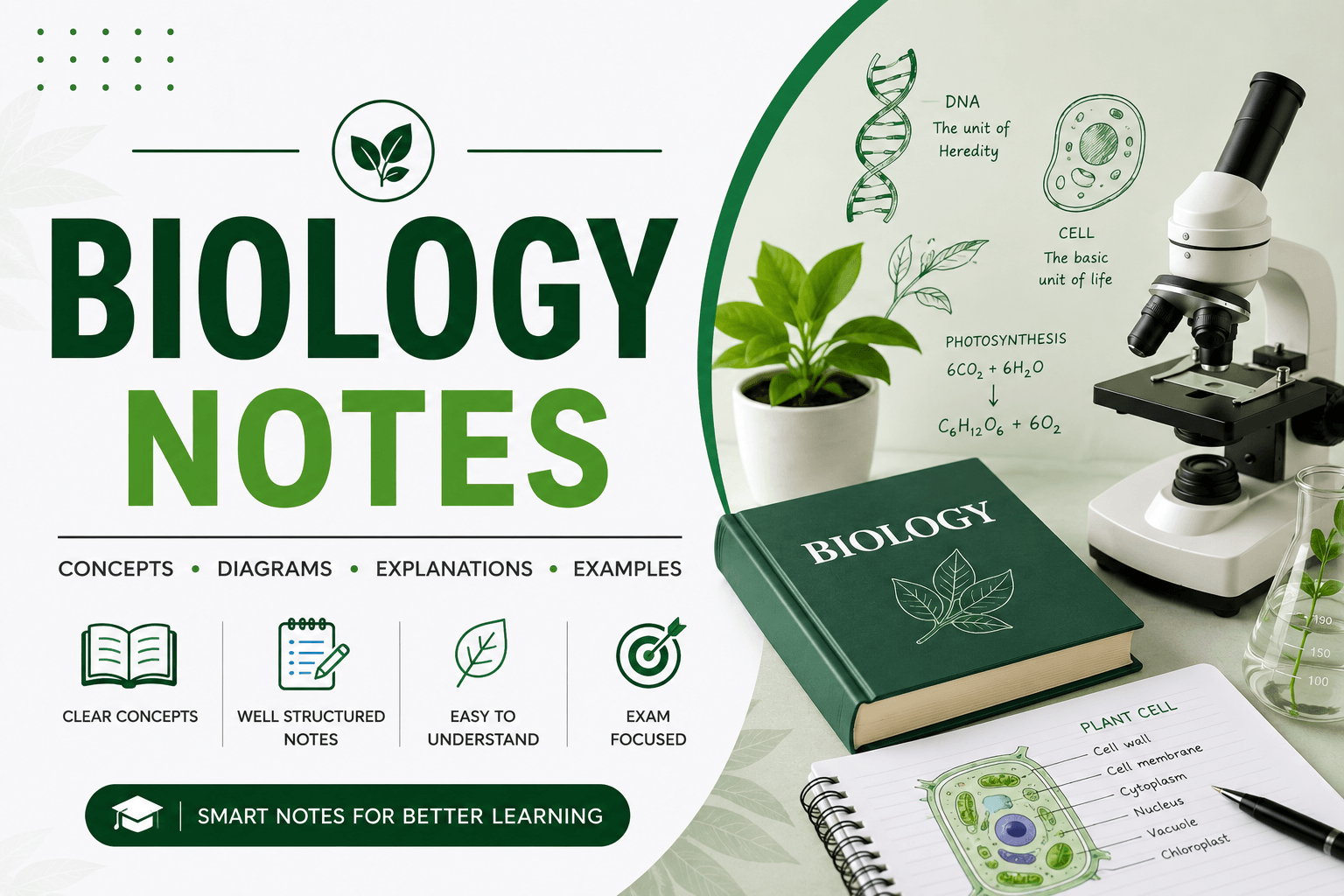
Biology Notes for SSC, Railway & Competitive Exams
Biology is an important part of General Science for SSC, Railway, Banking, Defence, Police and other competitive examinations. These notes explain important biological concepts in simple English with easy-to-understand examples, tables and revision points.
Introduction
Biology is the branch of science that studies living organisms, including plants, animals, microorganisms and humans. It explains how living organisms grow, reproduce, obtain nutrition and interact with their environment.
Biology is one of the most important scoring subjects in General Science. Questions are frequently asked from cells, tissues, human body systems, vitamins, diseases, plants and animals.
- Cell
- Tissues
- Human Body Systems
- Blood
- Vitamins
- Diseases
- Plant Kingdom
- Animal Kingdom
Characteristics of Living Organisms
Living organisms possess certain common characteristics that distinguish them from non-living things.
| Characteristic | Description |
|---|---|
| Growth | Increase in size and development. |
| Respiration | Release of energy from food. |
| Nutrition | Obtaining and utilizing food. |
| Reproduction | Production of offspring. |
| Excretion | Removal of waste materials. |
| Response | Reaction to environmental stimuli. |
- All living organisms are made up of cells.
- Living organisms require energy for survival.
- Growth and reproduction are major characteristics of life.
Quick Revision
- Growth
- Nutrition
- Respiration
- Reproduction
- Excretion
Cell – The Basic Unit of Life
The cell is the smallest structural and functional unit of life. Every living organism is made up of one or more cells.
- Cell Theory
- Plant Cell
- Animal Cell
- Cell Organelles
| Scientist | Contribution |
|---|---|
| Robert Hooke | Discovered cells in 1665. |
| Matthias Schleiden | Proposed that plants are made of cells. |
| Theodor Schwann | Proposed that animals are made of cells. |
| Rudolf Virchow | Stated that every cell arises from a pre-existing cell. |
- Robert Hooke discovered the cell in cork.
- The cell is called the basic unit of life.
- Unicellular organisms have only one cell.
- Multicellular organisms have many cells.
Plant Cell vs Animal Cell
| Feature | Plant Cell | Animal Cell |
|---|---|---|
| Cell Wall | Present | Absent |
| Chloroplast | Present | Absent |
| Vacuole | Large | Small |
| Shape | Fixed | Irregular |
Animal Cell → No Cell Wall
Quick Revision
- Cell Wall → Plant Only
- Chloroplast → Plant Only
- Large Vacuole → Plant Cell
Cell Organelles
Cell organelles are specialized structures that perform specific functions inside the cell.
| Organelle | Function |
|---|---|
| Nucleus | Controls all cell activities. |
| Mitochondria | Produces energy (Powerhouse of the Cell). |
| Ribosomes | Protein synthesis. |
| Endoplasmic Reticulum | Transport of materials. |
| Golgi Apparatus | Packing and secretion. |
| Lysosomes | Digestion of waste materials. |
| Chloroplast | Photosynthesis. |
- Mitochondria → Powerhouse of the Cell.
- Ribosomes → Protein Factory.
- Lysosomes → Suicidal Bags of the Cell.
- Nucleus → Control Centre of the Cell.
- Chloroplast contains chlorophyll.
Quick Revision
- Nucleus → Control Centre
- Mitochondria → Energy
- Ribosomes → Protein
- Lysosomes → Digestion
- Chloroplast → Photosynthesis
Tissues
A tissue is a group of similar cells that work together to perform a specific function.
| Plant Tissues | Animal Tissues |
|---|---|
| Meristematic Tissue | Epithelial Tissue |
| Permanent Tissue | Connective Tissue |
| Muscular Tissue | |
| Nervous Tissue |
- Meristematic tissue is responsible for plant growth.
- Muscular tissue helps in movement.
- Nervous tissue transmits nerve impulses.
- Blood is a connective tissue.
Quick Revision
- Plant Growth → Meristematic Tissue
- Movement → Muscular Tissue
- Blood → Connective Tissue
- Impulse → Nervous Tissue
Levels of Biological Organization
Living organisms are organized from simple to complex levels.
📘 Remember
Cell → Tissue → Organ → Organ System → Organism- Cell → Muscle Cell
- Tissue → Muscular Tissue
- Organ → Heart
- Organ System → Circulatory System
- Organism → Human Being
Quick Revision
- Smallest Unit → Cell
- Group of Cells → Tissue
- Group of Tissues → Organ
- Group of Organs → Organ System
Human Digestive System
The digestive system breaks down food into simpler substances so that nutrients can be absorbed and used by the body for energy, growth and repair.
- Digestive Organs
- Digestive Enzymes
- Functions of Liver & Pancreas
- Small Intestine
| Organ | Main Function |
|---|---|
| Mouth | Chewing of food and digestion of starch begins. |
| Oesophagus | Transfers food to the stomach. |
| Stomach | Digests proteins with the help of gastric juice. |
| Liver | Produces bile juice for fat digestion. |
| Pancreas | Produces digestive enzymes. |
| Small Intestine | Completes digestion and absorbs nutrients. |
| Large Intestine | Absorbs water and forms faeces. |
- The liver is the largest gland in the human body.
- The small intestine is the longest part of the digestive system.
- Most nutrient absorption takes place in the small intestine.
Quick Revision
- Largest Gland → Liver
- Longest Part → Small Intestine
- Water Absorption → Large Intestine
Human Respiratory System
The respiratory system helps in the exchange of gases. It supplies oxygen to the body and removes carbon dioxide produced during respiration.
| Organ | Function |
|---|---|
| Nose | Filters, warms and moistens air. |
| Trachea | Passage for air to the lungs. |
| Lungs | Exchange oxygen and carbon dioxide. |
| Alveoli | Site of gaseous exchange. |
- The right lung has three lobes.
- The left lung has two lobes.
- Alveoli increase the surface area for gas exchange.
Quick Revision
- Gas Exchange → Alveoli
- Respiratory Organ → Lungs
- Breathing Gas → Oxygen
Human Circulatory System
The circulatory system transports oxygen, nutrients, hormones and waste materials throughout the body. It consists of the heart, blood and blood vessels.
| Component | Function |
|---|---|
| Heart | Pumps blood throughout the body. |
| Arteries | Carry blood away from the heart. |
| Veins | Carry blood towards the heart. |
| Capillaries | Exchange materials between blood and tissues. |
- Heart Chambers
- Arteries & Veins
- Double Circulation
- The human heart has four chambers.
- The left ventricle has the thickest wall.
- The pulmonary artery carries deoxygenated blood.
- The pulmonary vein carries oxygenated blood.
Quick Revision
- Heart Chambers → 4
- Away from Heart → Arteries
- Towards Heart → Veins
- Exchange → Capillaries
Human Excretory System
The excretory system removes waste products and maintains the balance of water and salts in the body. The kidneys are the main organs of excretion.
| Organ | Function |
|---|---|
| Kidneys | Filter blood and produce urine. |
| Ureters | Carry urine from kidneys to urinary bladder. |
| Urinary Bladder | Stores urine. |
| Urethra | Removes urine from the body. |
- Humans have two kidneys.
- The functional unit of the kidney is the nephron.
- Urea is the major nitrogenous waste in humans.
Quick Revision
- Main Organ → Kidney
- Functional Unit → Nephron
- Waste Product → Urea
Human Blood
Blood is a fluid connective tissue that transports oxygen, nutrients, hormones and waste products throughout the body.
| Component | Function |
|---|---|
| Red Blood Cells (RBCs) | Transport oxygen. |
| White Blood Cells (WBCs) | Protect the body against infections. |
| Platelets | Help in blood clotting. |
| Plasma | Transports nutrients and hormones. |
- Haemoglobin is present in RBCs.
- WBCs provide immunity.
- Platelets prevent excessive blood loss.
- Normal blood pH is approximately 7.4.
Quick Revision
- RBC → Oxygen
- WBC → Immunity
- Platelets → Clotting
- Haemoglobin → RBC
Important Human Organs
| Organ | Main Function |
|---|---|
| Brain | Controls body activities. |
| Heart | Pumps blood. |
| Liver | Produces bile and performs metabolism. |
| Lungs | Exchange gases. |
| Kidneys | Filter blood and produce urine. |
| Skin | Protects the body and regulates temperature. |
Largest Internal Organ → Liver
Largest Gland → Liver
Hardest Substance → Tooth Enamel
Quick Revision
- Largest Organ → Skin
- Largest Internal Organ → Liver
- Largest Gland → Liver
- Hardest Substance → Tooth Enamel
Human Nervous System
The nervous system controls and coordinates all activities of the human body. It receives information from the surroundings, processes it and sends appropriate responses to different organs.
- Brain
- Spinal Cord
- Neuron
- Reflex Action
| Part | Main Function |
|---|---|
| Brain | Controls body activities and thinking. |
| Spinal Cord | Conducts nerve impulses and controls reflex actions. |
| Nerves | Carry messages between the brain and body. |
| Neuron | Basic structural and functional unit of the nervous system. |
- The brain is protected by the skull.
- The spinal cord is protected by the vertebral column.
- Reflex actions occur without conscious thinking.
Quick Revision
- Control Centre → Brain
- Basic Unit → Neuron
- Reflex Centre → Spinal Cord
Endocrine Glands and Hormones
Endocrine glands secrete hormones directly into the bloodstream. Hormones regulate growth, metabolism, reproduction and many other body functions.
| Gland | Main Hormone / Function |
|---|---|
| Pituitary Gland | Growth Hormone (Master Gland) |
| Thyroid Gland | Thyroxine |
| Pancreas | Insulin |
| Adrenal Gland | Adrenaline |
| Testes | Testosterone |
| Ovaries | Estrogen & Progesterone |
- The pituitary gland is called the “Master Gland”.
- Insulin helps regulate blood sugar levels.
- Thyroxine controls metabolism.
- Adrenaline is released during emergency situations.
Quick Revision
- Master Gland → Pituitary
- Insulin → Pancreas
- Thyroxine → Thyroid
- Adrenaline → Adrenal Gland
Human Reproductive System (Basic)
The reproductive system enables the production of offspring and ensures the continuation of human life. For competitive examinations, only the basic concepts are generally asked.
| Organ | Main Function |
|---|---|
| Testes | Produce sperm and testosterone. |
| Ovaries | Produce ova (eggs) and female hormones. |
| Uterus | Development of the embryo and fetus. |
Quick Revision
- Male Gamete → Sperm
- Female Gamete → Ovum (Egg)
- Embryo Develops → Uterus
Plant Kingdom
Plants are multicellular organisms that prepare their own food through photosynthesis. They contain chlorophyll, which captures sunlight for food production.
| Group | Example |
|---|---|
| Algae | Spirogyra |
| Bryophytes | Moss |
| Pteridophytes | Fern |
| Gymnosperms | Pine |
| Angiosperms | Mango, Rose, Wheat |
- Angiosperms are flowering plants.
- Gymnosperms produce naked seeds.
- Bryophytes are known as the “Amphibians of the Plant Kingdom”.
Quick Revision
- Flowering Plants → Angiosperms
- Naked Seeds → Gymnosperms
- Amphibians of Plants → Bryophytes
Animal Kingdom
Animals are multicellular organisms that cannot prepare their own food. They depend directly or indirectly on plants for nutrition.
| Group | Example |
|---|---|
| Pisces | Fish |
| Amphibia | Frog |
| Reptilia | Snake, Lizard |
| Aves | Pigeon, Peacock |
| Mammalia | Human, Cow, Tiger |
- Mammals possess mammary glands.
- Birds are warm-blooded and lay eggs.
- Amphibians live both on land and in water.
- Reptiles are cold-blooded animals.
Quick Revision
- Fish → Pisces
- Frog → Amphibia
- Snake → Reptilia
- Birds → Aves
- Humans → Mammalia
Nutrition in Plants
Green plants prepare their own food by the process of photosynthesis. Chlorophyll absorbs sunlight and uses carbon dioxide and water to produce glucose and oxygen.
📘 Photosynthesis
Carbon Dioxide + Water+ Sunlight + Chlorophyll
→ Glucose + Oxygen
- Photosynthesis takes place mainly in leaves.
- Chlorophyll is the green pigment present in chloroplasts.
- Plants release oxygen during photosynthesis.
- Stomata help in gaseous exchange.
Stomata → Gas Exchange
Quick Revision
- Food Making → Photosynthesis
- Green Pigment → Chlorophyll
- Gas Exchange → Stomata
- Food Produced → Glucose
Vitamins and Deficiency Diseases
Vitamins are essential organic nutrients required by the body in small amounts for normal growth, development and proper functioning. A deficiency of vitamins can lead to various diseases.
- Vitamin Sources
- Deficiency Diseases
- Fat-Soluble & Water-Soluble Vitamins
| Vitamin | Main Function | Deficiency Disease |
|---|---|---|
| Vitamin A | Healthy Eyes & Skin | Night Blindness |
| Vitamin B₁ | Nervous System | Beriberi |
| Vitamin B₂ | Growth & Skin Health | Cheilosis |
| Vitamin B₁₂ | Formation of Red Blood Cells | Megaloblastic Anemia |
| Vitamin C | Wound Healing & Immunity | Scurvy |
| Vitamin D | Healthy Bones & Teeth | Rickets (Children), Osteomalacia (Adults) |
| Vitamin E | Protects Cells | Rare Deficiency |
| Vitamin K | Blood Clotting | Excessive Bleeding |
- Vitamins A, D, E and K are fat-soluble vitamins.
- Vitamin B Complex and Vitamin C are water-soluble vitamins.
- Vitamin D is also called the “Sunshine Vitamin”.
Quick Revision
- Vitamin A → Night Blindness
- Vitamin B₁ → Beriberi
- Vitamin C → Scurvy
- Vitamin D → Rickets
- Vitamin K → Blood Clotting
Important Diseases and Causative Organisms
| Disease | Causative Organism |
|---|---|
| Tuberculosis (TB) | Bacteria |
| Typhoid | Bacteria |
| Cholera | Bacteria |
| Malaria | Protozoa (Plasmodium) |
| Dengue | Virus |
| Rabies | Virus |
| Ringworm | Fungus |
| Amoebiasis | Protozoa |
- Malaria spreads through the bite of an infected female Anopheles mosquito.
- Dengue spreads through the bite of an infected Aedes mosquito.
- Tuberculosis mainly affects the lungs.
- Cholera spreads through contaminated food and water.
Quick Revision
- TB → Bacteria
- Malaria → Protozoa
- Dengue → Virus
- Ringworm → Fungus
Vaccines and Immunity
Vaccines help the body develop immunity against infectious diseases by stimulating the immune system to produce antibodies.
| Vaccine | Protects Against |
|---|---|
| BCG | Tuberculosis |
| OPV | Polio |
| DPT | Diphtheria, Pertussis & Tetanus |
| MMR | Measles, Mumps & Rubella |
| Hepatitis B Vaccine | Hepatitis B |
- Vaccination is one of the most effective methods of disease prevention.
- White Blood Cells (WBCs) play a major role in immunity.
- Antibodies help destroy disease-causing microorganisms.
Quick Revision
- BCG → Tuberculosis
- OPV → Polio
- DPT → Diphtheria, Pertussis & Tetanus
- WBC → Immunity
Important Scientists and Their Contributions
| Scientist | Contribution |
|---|---|
| Aristotle | Father of Biology |
| Carolus Linnaeus | Father of Taxonomy |
| Charles Darwin | Theory of Evolution |
| Gregor Mendel | Father of Genetics |
| Louis Pasteur | Pasteurization & Germ Theory |
| Edward Jenner | Smallpox Vaccine |
| Robert Koch | Discovery of TB Bacteria |
| Alexander Fleming | Discovery of Penicillin |
Most Frequently Asked Biology Facts
📌 One-Minute Revision
- ✔ Cell is the basic unit of life.
- ✔ Mitochondria → Powerhouse of the Cell.
- ✔ Ribosomes → Protein Synthesis.
- ✔ Blood is a connective tissue.
- ✔ Largest Gland → Liver.
- ✔ Largest Organ → Skin.
- ✔ Heart has four chambers.
- ✔ Nephron → Functional Unit of Kidney.
- ✔ RBC transports oxygen.
- ✔ WBC provides immunity.
- ✔ Platelets help in blood clotting.
- ✔ Vitamin A → Night Blindness.
- ✔ Vitamin C → Scurvy.
- ✔ Vitamin D → Rickets.
- ✔ Vitamin K → Blood Clotting.
- ✔ Malaria → Protozoa.
- ✔ Dengue → Virus.
- ✔ BCG → Tuberculosis.
- ✔ Father of Genetics → Gregor Mendel.
- ✔ Father of Biology → Aristotle.
Conclusion
Biology is one of the most important and highest-scoring subjects in General Science for SSC, Railway, Banking, Defence, Police and State Government examinations. Topics such as cells, human body systems, vitamins, diseases, plants, animals and important scientists are frequently asked in competitive exams.
Regular revision of important concepts, scientific facts, deficiency diseases, vaccines and biological terminology will improve your understanding and help you answer objective questions with confidence. Along with these notes, solving topic-wise MCQs is the best way to strengthen your preparation.
These Biology Notes are designed in a simple, exam-oriented format to help beginners and competitive exam aspirants revise quickly and effectively. Bookmark this page and revise it regularly for better performance in upcoming examinations.