
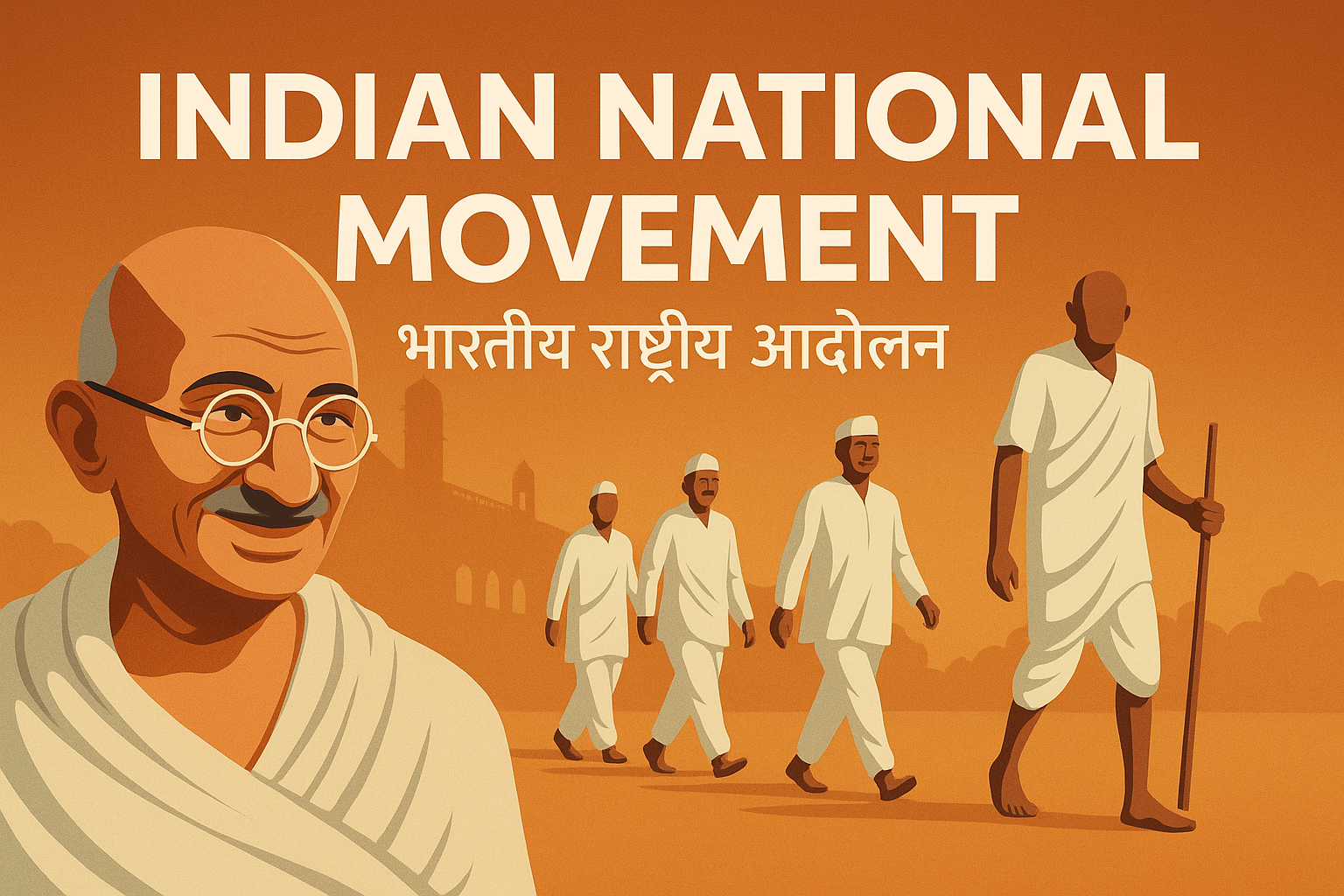

🇮🇳 Indian National Movement (1885–1947) – Notes for Competitive Exams
Introduction:
The Indian National Movement was the struggle through which the people of India gained freedom from British rule.
It began with the establishment of the Indian National Congress in 1885 and culminated in India’s independence on 15 August 1947.
This topic is one of the most important chapters for SSC, Railway, UPSC, and State Exams.
📌 Phases of the Indian National Movement
✨ Early Phase (1885–1905)
- Formation of the Indian National Congress – 1885, A. O. Hume.
- Moderate leaders – Dadabhai Naoroji, Gopal Krishna Gokhale, Ferozeshah Mehta.
- Policy – Prayer, petitions, and constitutional methods.
- Dadabhai Naoroji’s “Drain of Wealth Theory”.
✨ Extremist Phase (1905–1919)
- Prominent leaders – Bal Gangadhar Tilak, Bipin Chandra Pal, Lala Lajpat Rai.
- 1905 – Partition of Bengal and the Swadeshi Movement.
- 1907 – Surat Split (Moderates vs Extremists).
- 1916 – Lucknow Session, agreement between Congress and Muslim League.
📌 Tilak’s slogan – “Swaraj is my birthright and I shall have it.”
✨ Gandhian Era (1919–1947)
- 1919 – Rowlatt Act and Jallianwala Bagh Massacre.
- 1920 – Non-Cooperation Movement.
- 1930 – Civil Disobedience Movement and Dandi March.
- 1942 – Quit India Movement.
- Under Mahatma Gandhi, the movement became a mass movement.
✨ Revolutionary Activities
- Bhagat Singh, Chandrashekhar Azad, Rajguru, Sukhdev.
- Hindustan Socialist Republican Association (HSRA).
- Kakori Conspiracy (1925).
✨ Attainment of Independence (1947)
- Britain weakened after the Second World War.
- 1946 – Cabinet Mission Plan.
- 15 August 1947 – India became independent, along with Partition into India and Pakistan.
🎯 Key Points for Exams:
✦ 1885 – Formation of Indian National Congress.
✦ 1905 – Partition of Bengal and Swadeshi Movement.
✦ 1920 – Non-Cooperation Movement.
✦ 1930 – Dandi March and Civil Disobedience Movement.
✦ 1942 – Quit India Movement.
✦ 1947 – Independence and Partition.
✦ 1885 – Formation of Indian National Congress.
✦ 1905 – Partition of Bengal and Swadeshi Movement.
✦ 1920 – Non-Cooperation Movement.
✦ 1930 – Dandi March and Civil Disobedience Movement.
✦ 1942 – Quit India Movement.
✦ 1947 – Independence and Partition.
❓ Expected MCQs
Q1. When was the Indian National Congress founded?
➡️ Answer: 1885
Q2. Who gave the “Drain of Wealth Theory”?
➡️ Answer: Dadabhai Naoroji
Q3. Who said “Swaraj is my birthright and I shall have it”?
➡️ Answer: Bal Gangadhar Tilak
Q4. The Dandi March was part of which movement?
➡️ Answer: Civil Disobedience Movement
Q5. When was the Quit India Movement launched?
➡️ Answer: 1942
🏆 Conclusion
The Indian National Movement forms the foundation of India’s freedom struggle. Moderates, extremists, revolutionaries, and Gandhian movements all played a vital role. Ultimately, India achieved independence on 15 August 1947. This topic is extremely important for competitive examinations.
📝 Practice Quiz
Practice questions based on this topic and strengthen your preparation.
👉 Start Quiz