
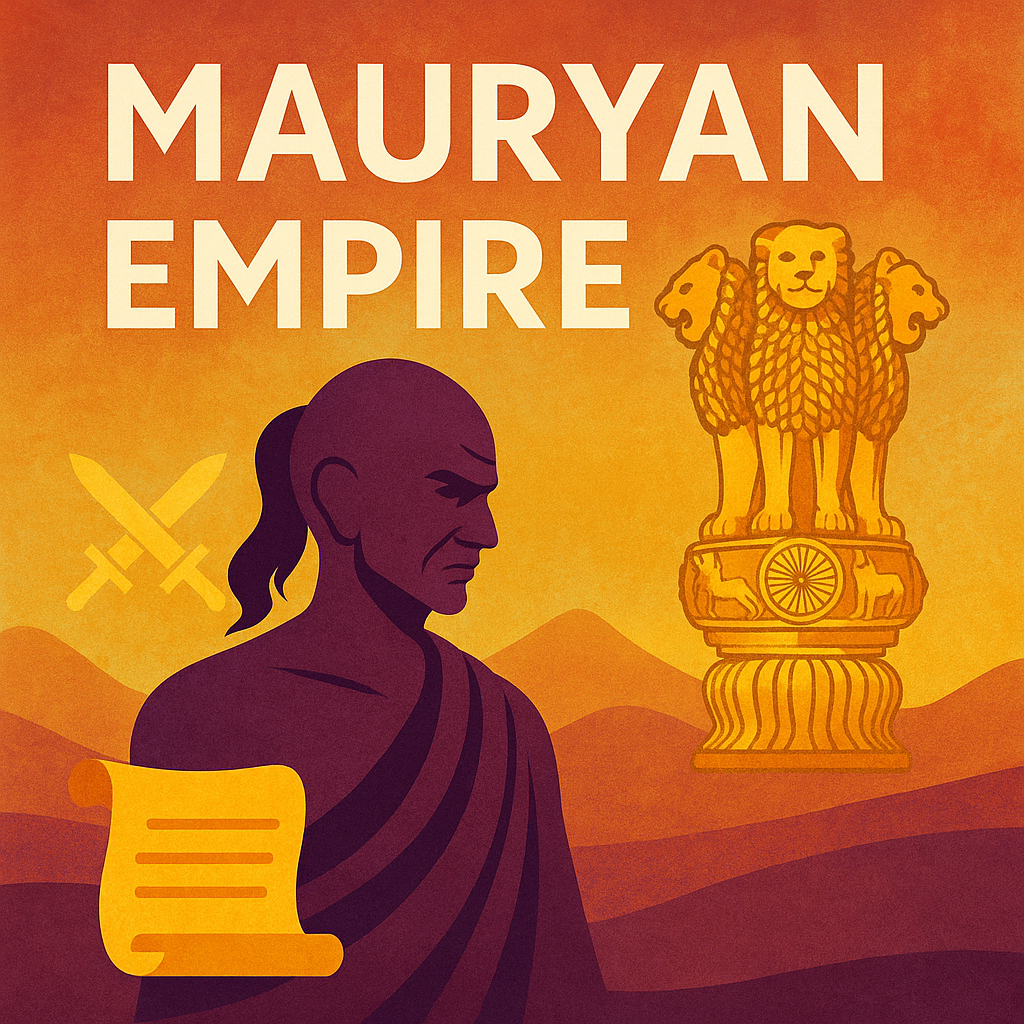

🏰 Mauryan Empire – Notes for Competitive Exams
Introduction:
The Mauryan Empire was the first large and centralized empire in India.
It was founded by Chandragupta Maurya in 321 BC and lasted till 185 BC.
During the Mauryan period, the political, economic, and cultural development of the Indian subcontinent reached its peak.
Every year, 5–6 questions from the Mauryan period are asked in Railway, SSC, UPSC, and State-level examinations.
👑 Mauryan Rulers
- Chandragupta Maurya (321–297 BC) – Founder of the empire, gained power with the help of Chanakya (Kautilya).
- Bindusara (297–273 BC) – Known by the title “Amitraghata”, expanded the empire up to South India.
- Ashoka (273–232 BC) – Greatest Mauryan ruler, adopted Buddhism after the Kalinga War (261 BC).
📌 The Greek traveler Megasthenes visited the court of Chandragupta Maurya. His book Indica provides information about the Mauryan period.
⚔️ Kalinga War and Ashoka’s Dhamma
- The Kalinga War was fought in 261 BC against Kalinga (modern Odisha).
- The massive bloodshed and destruction deeply affected Ashoka.
- After this war, Ashoka adopted Buddhism and followed the policy of Dhamma.
- He promoted non-violence, tolerance, religious harmony, and compassion.
📌 Ashoka was also known by the titles Devanampriya and Priyadarshi.
🏛️ Administration
- The king was the supreme authority.
- Council of ministers – included scholars like Chanakya.
- Administrative system extended down to district and village levels.
- Well-organized spy system for security.
📌 Arthashastra by Kautilya gives a detailed account of Mauryan administration and economy.
💰 Economy
- Agriculture was the main base; irrigation facilities were developed.
- Land revenue was the chief source of state income.
- Internal and external trade flourished.
- Roads and transport system were well developed.
🎨 Art and Culture
- Ashokan pillars – Lion Capital of Sarnath (National Emblem of India).
- Caves – Barabar caves (Bihar).
- Inscriptions and edicts written in Brahmi and Kharosthi scripts.
📜 Decline of the Mauryan Empire
- Weak successors after Ashoka.
- Administrative difficulties in controlling a vast empire.
- Rebellions and invasions.
- The last ruler – Brihadratha Maurya, who was killed by Pushyamitra Shunga, leading to the establishment of the Shunga dynasty.
🎯 Important Points for Exams:
✦ Founder – Chandragupta Maurya (321 BC).
✦ Megasthenes – Indica.
✦ Kalinga War – 261 BC; Ashoka adopted Buddhism.
✦ Titles of Ashoka – Devanampriya, Priyadarshi.
✦ Sarnath Lion Capital – National Emblem of India.
✦ Last ruler – Brihadratha Maurya.
✦ Founder – Chandragupta Maurya (321 BC).
✦ Megasthenes – Indica.
✦ Kalinga War – 261 BC; Ashoka adopted Buddhism.
✦ Titles of Ashoka – Devanampriya, Priyadarshi.
✦ Sarnath Lion Capital – National Emblem of India.
✦ Last ruler – Brihadratha Maurya.
❓ Expected MCQs
Q1. Who founded the Mauryan Empire?
➡️ Answer: Chandragupta Maurya
Q2. Megasthenes visited the court of which ruler?
➡️ Answer: Chandragupta Maurya
Q3. When was the Kalinga War fought?
➡️ Answer: 261 BC
Q4. Which Ashokan monument is the National Emblem of India?
➡️ Answer: Lion Capital of Sarnath
Q5. Who was the last ruler of the Mauryan dynasty?
➡️ Answer: Brihadratha Maurya
🏆 Conclusion
The Mauryan Empire was the first powerful and centralized empire in Indian history. Rulers like Chandragupta, Bindusara, and Ashoka brought glory to the empire. This topic is extremely important for competitive examinations.
📝 Practice Quiz
Practice questions based on this topic and strengthen your preparation.
👉 Start Quiz